
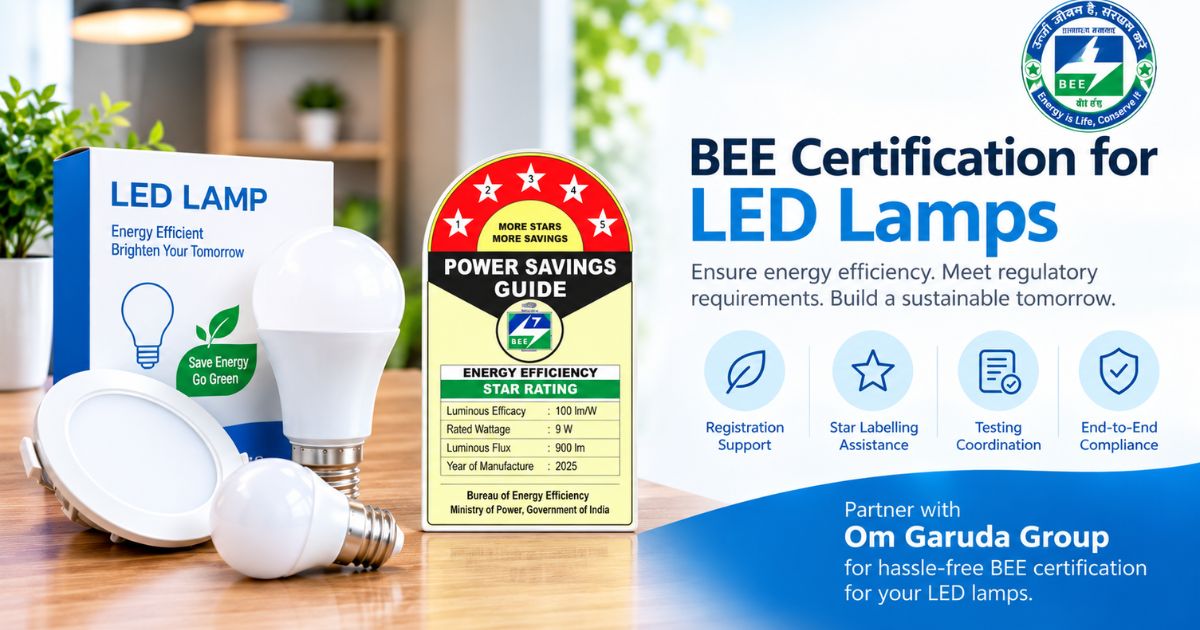
Manufacturers, importers, and brands planning to sell LED lamps in India should understand the applicable energy-efficiency labelling requirements established by the Bureau of Energy Efficiency (BEE). The BEE Standards & Labelling programme helps consumers compare the energy performance of eligible products and make informed purchasing decisions. Businesses must identify the correct product category and follow the relevant requirements before displaying a BEE star label.
BEE Certification for LED Lamps involves reviewing product eligibility, checking applicable energy-performance criteria, preparing technical documentation, and completing the prescribed registration and labelling formalities. The requirements depend on the LED lamp type, applicable regulations, and the applicant's role as a manufacturer, importer, or brand owner.
Om Garuda Group helps businesses understand the applicable compliance process, organise supporting documents, coordinate testing-related requirements, and prepare for the relevant application procedures. The objective is to help applicants approach BEE compliance systematically and reduce avoidable documentation errors.
Understanding BEE Star Rating for LED Lamps
LED lamps are designed to convert electrical energy into light efficiently. Their performance can vary according to luminous output, electrical power consumption, driver design, thermal management, and overall construction.
The BEE Standards & Labelling regulations for self-ballasted LED lamps describe energy-efficiency labelling based on luminous efficacy. Luminous efficacy measures the amount of visible light produced per unit of electrical power, generally expressed in lumens per watt (lm/W).
BEE Star Rating for LED Lamps communicates the energy-efficiency level according to the applicable criteria. Manufacturers should confirm the current requirements and applicable label period before finalising product specifications, packaging, or marketing claims.
BEE's official regulations identify self-ballasted LED lamps as a specific product category. Other lighting products, such as LED tubes, luminaires, and integrated lighting systems, should not automatically be assumed to follow identical BEE requirements.
BEE Registration for LED Lamps
BEE Registration for LED Lamps requires the applicant to establish the correct product category, review the applicable scheme, and prepare the prescribed information. The exact process should be confirmed against the latest BEE instructions and regulations.
Depending on the product and application, the supporting information may include:
- Manufacturer, importer, and brand details.
- Product model number and trade name.
- Electrical ratings and technical specifications.
- Rated wattage and luminous output information, where applicable.
- Test reports and performance evidence required by the scheme.
- Product photographs and proposed label particulars.
- Authorisation documents and prescribed declarations.
- Applicable application and label-related fees.
Applicants should check the current requirements before submitting documents. Inconsistent model numbers, incomplete technical details, or test evidence that does not match the product can lead to clarification requests and additional work.
BEE Certification Process for LED Lamps
A structured application process helps businesses identify compliance gaps before submission. The following stages provide a general overview, subject to the current scheme requirements.
1. Confirm Product Eligibility
Identify whether the product is a self-ballasted LED lamp covered by the applicable BEE regulations. Product construction, intended use, and category definitions should be reviewed before choosing the application route.
2. Review Applicable Standards and Labelling Rules
Check the current BEE regulations, applicable energy-performance criteria, label particulars, and validity provisions. Use the official requirements rather than relying on an outdated checklist or a rating table from a previous label period.
3. Arrange Testing and Technical Evaluation
Testing should follow the applicable procedure and cover the required performance parameters. The test evidence must relate to the product being submitted. Applicants should confirm whether an existing report is acceptable before relying on it for a new model or product variant.
4. Prepare and Submit the Application
Compile the required business details, technical documents, test reports, and declarations. Verify that the information is consistent throughout the application and supporting records before submission through the prescribed process.
5. Complete Labelling Formalities
Follow the applicable review process and address any queries raised by the competent authority. Businesses should use BEE labels only when the required permission has been granted and in accordance with the applicable conditions.
BEE Certification Consultant for LED Lamps in India
Working with a consultant can help manufacturers and importers understand the relevant requirements before they invest time and resources in an application. BEE Certification Consultant for LED Lamps in India support can be particularly useful for businesses launching new products or managing several model variants.
Om Garuda Group can assist with:
- Reviewing product specifications and applicant information.
- Identifying the relevant compliance route.
- Checking documentation for completeness and consistency.
- Coordinating testing-related requirements.
- Preparing application documents and supporting records.
- Helping address documentation queries.
- Providing guidance on applicable labelling formalities.
A BEE Registration Consultant for LED Lamps can also help businesses assess whether different models require separate applications or additional evidence. The requirements should be confirmed for each model instead of assuming that one report or registration covers every product in a range.
BEE Compliance for LED Lamps
Compliance responsibilities can continue after an application is completed. Businesses should follow the conditions attached to their permission, maintain accurate records, and review regulatory changes that may affect their products.
A BEE Compliance Consultant for LED Lamps can help applicants review product changes, label information, supporting reports, and applicable validity requirements. Changes to electrical design, driver components, wattage, or light output may require an assessment to determine whether existing documentation remains appropriate.
Manufacturers and importers should also check whether separate product-safety or quality-control requirements apply. BEE energy-efficiency labelling and BIS certification serve different regulatory purposes. A BEE label should not be presented as a substitute for any separately applicable BIS requirement.
BEE Certification Cost for LED Lamps
The BEE Certification Cost for LED Lamps depends on the applicable official fees, testing requirements, number of models, documentation readiness, and consultancy scope. A single fixed price cannot be reliably quoted without reviewing the product and current scheme requirements.
The overall cost may include:
- Applicable BEE application or label-related fees.
- Laboratory testing and technical evaluation charges.
- Document preparation and application support.
- Additional testing or corrective work, if needed.
- Professional consultancy and coordination fees.
Businesses should request an itemised quotation that distinguishes official charges from testing expenses and consultancy fees. Om Garuda Group can review the proposed product scope and help applicants understand the likely cost components before proceeding.
LED Lamp BEE Certification Services in India
Om Garuda Group provides compliance support for businesses seeking LED Lamp BEE Certification Services in India. Assistance may include reviewing product information, identifying applicable requirements, coordinating testing, preparing documents, and guiding applicants through the relevant application process.
Businesses seeking BEE Star Label Approval for LED Lamp Manufacturers should first confirm product eligibility, current performance criteria, and the prescribed application route. The final star level and permission depend on the applicable regulations and the competent authority's review; consultancy support cannot guarantee a particular outcome.
Contact Om Garuda Group to discuss your LED lamp models, existing test reports, documentation status, and planned market launch. A preliminary review can help identify the next compliance steps for your business.