
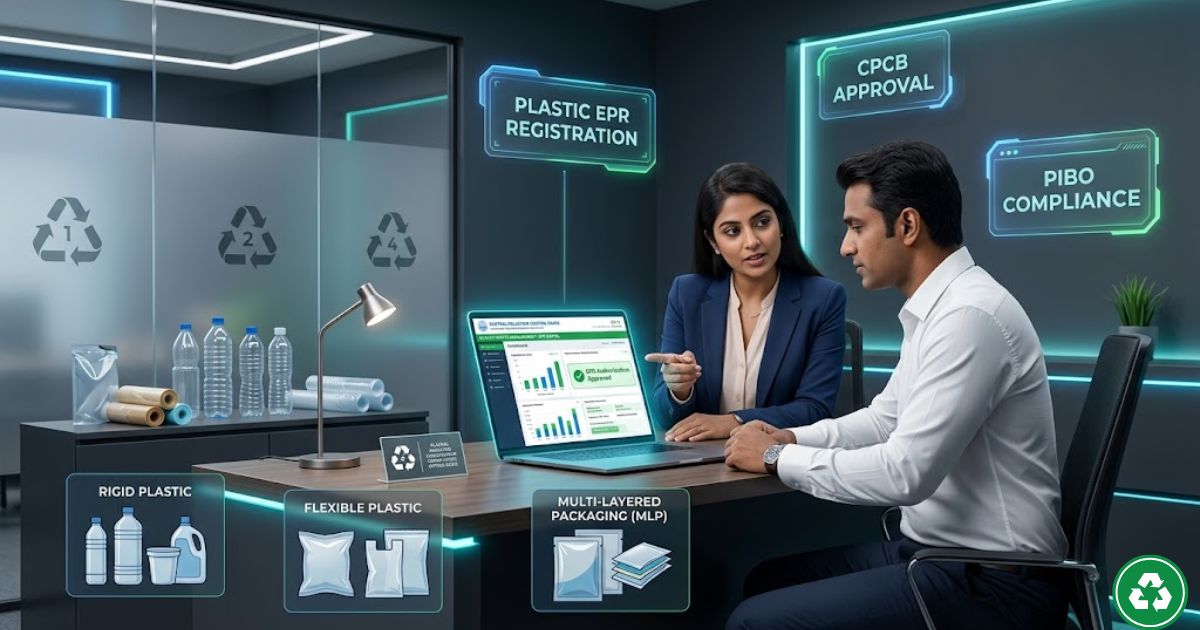
EPR registration for plastic waste is a mandatory regulatory requirement for businesses introducing plastic packaging into the Indian market. Under the Plastic Waste Management Rules, entities classified as Producers, Importers, and Brand Owners (PIBO) must ensure responsible collection, recycling, and disposal of plastic waste generated from their products.
Om Garuda Group provides end-to-end support for EPR registration for plastic waste, helping businesses obtain CPCB authorization, meet compliance targets, and avoid regulatory penalties. Our process is structured to align with the requirements of the Central Pollution Control Board, ensuring accurate application and faster approvals.
What is EPR Registration for Plastic Waste?
Extended Producer Responsibility (EPR) is a compliance framework that shifts the responsibility of plastic waste management from local authorities to the producers introducing plastic into the market.
Under this system, businesses must:
- Register with CPCB
- Declare plastic usage data
- Meet recycling targets through authorized recyclers
- File annual compliance reports
EPR registration for plastic waste is not just a formality. It is a legally enforceable obligation under India’s environmental regulations. Businesses failing to comply may face financial penalties and operational restrictions.
Who Needs EPR Registration for Plastic Waste?
Any entity introducing plastic packaging into the Indian market must apply for EPR registration. This includes:
- FMCG companies using plastic packaging
- E-commerce sellers shipping products in plastic materials
- Importers of packaged goods
- Manufacturers producing plastic packaging
If your business sells packaged products, you fall under the scope of extended producer responsibility plastic waste in India, regardless of company size.
Many businesses search for EPR registration plastic packaging PIBO when trying to understand their obligations. The classification of your business plays a critical role in determining your compliance requirements.
Understanding PIBO Under Plastic EPR
The CPCB categorizes entities into three groups:
Producer
Manufacturers of plastic packaging materials.
Importer
Entities importing plastic packaging or products packed in plastic.
Brand Owner
Businesses selling products under their own brand name using plastic packaging.
Correct classification is essential. Misidentifying your category can lead to rejection or compliance issues later.
Plastic Categories Under EPR
Plastic waste is further divided into categories, each with different compliance requirements:
- Category I: Rigid plastic packaging
- Category II: Flexible plastic packaging
- Category III: Multi-layered plastic packaging
- Category IV: Compostable plastic
Your EPR obligations depend on the type and quantity of plastic you introduce into the market. This is why accurate data reporting is critical during application.
CPCB Plastic Waste EPR Registration Process
The process for CPCB plastic waste EPR registration involves multiple technical steps. Errors at any stage can delay approval.
1. Business Classification
Identify whether your entity falls under Producer, Importer, or Brand Owner.
2. Data Collection
Compile details of plastic packaging used, including category and quantity.
3. Documentation Preparation
Prepare all required legal and operational documents.
4. CPCB Portal Registration
Submit the application through the CPCB EPR portal.
5. EPR Action Plan
Define how your business will meet recycling targets through authorized recyclers or PROs.
6. CPCB Review
Authorities evaluate your application and may request clarifications.
7. Authorization Approval
Upon approval, CPCB issues EPR authorization.
Om Garuda Group manages this entire workflow to ensure your application is accurate and compliant.
Documents Required for Plastic EPR Registration
Proper documentation is essential for approval. Required documents typically include:
- GST registration certificate
- PAN card of the business
- IEC code (for importers)
- Company incorporation documents
- Details of plastic packaging (type & quantity)
- Sales and distribution data
- Agreement with authorized recyclers or PROs
- Authorized signatory details
Incomplete or inconsistent documentation is one of the main reasons for application rejection.
Plastic Packaging EPR Certificate in India - What You Receive
Businesses often search for a plastic packaging EPR certificate in India, but the actual document issued by CPCB is an EPR Authorization.
This authorization:
- Confirms your compliance with Plastic Waste Management Rules
- Specifies your recycling obligations
- Allows legal sale and distribution of packaged goods
Without this authorization, your business may face restrictions from regulators and online marketplaces.
EPR Targets and Compliance Obligations
After receiving approval, businesses must fulfill ongoing compliance requirements.
These include:
- Meeting annual recycling targets defined by CPCB
- Working with registered recyclers
- Maintaining records of plastic waste collection
- Filing annual returns on the CPCB portal
EPR registration for plastic waste is not a one-time process. Continuous compliance is required to maintain authorization.
Timeline for EPR Registration
The approval timeline depends on application accuracy and documentation readiness.
- Typical timeline: 20 to 45 working days
- Delays occur due to:
- Incorrect classification
- Incomplete documentation
- CPCB queries
A properly prepared application reduces processing time significantly.
Cost Factors for Plastic EPR Registration
There is no fixed cost for EPR registration because it depends on multiple variables:
- Type of entity (Producer, Importer, Brand Owner)
- Volume of plastic introduced into the market
- Plastic category classification
- Complexity of compliance plan
Low-cost service providers often compromise on accuracy, which can lead to rejection or future compliance issues.
Penalties for Non-Compliance
Non-compliance with plastic EPR regulations can have serious consequences:
- Environmental compensation charges
- Suspension of business operations
- Ban on product sales
- Delisting from e-commerce platforms
If your business depends on packaged goods, ignoring EPR registration can directly impact revenue and operations.
Why Choose Om Garuda Group for Plastic EPR Registration?
EPR compliance requires more than just form submission. It requires technical understanding and regulatory accuracy.
Om Garuda Group provides:
- Accurate PIBO classification
- Complete documentation support
- EPR action plan preparation
- CPCB application handling and follow-ups
- Post-approval compliance support
Our approach ensures that your EPR registration for plastic waste is handled correctly from start to finish.
Get Started with Plastic EPR Registration
If your business deals with plastic packaging and you have not completed EPR registration for plastic waste, you are operating at compliance risk.
Om Garuda Group helps you navigate CPCB regulations with a structured and technically accurate approach, ensuring faster approvals and long-term compliance.
Connect with our experts today to start your EPR registration process.