
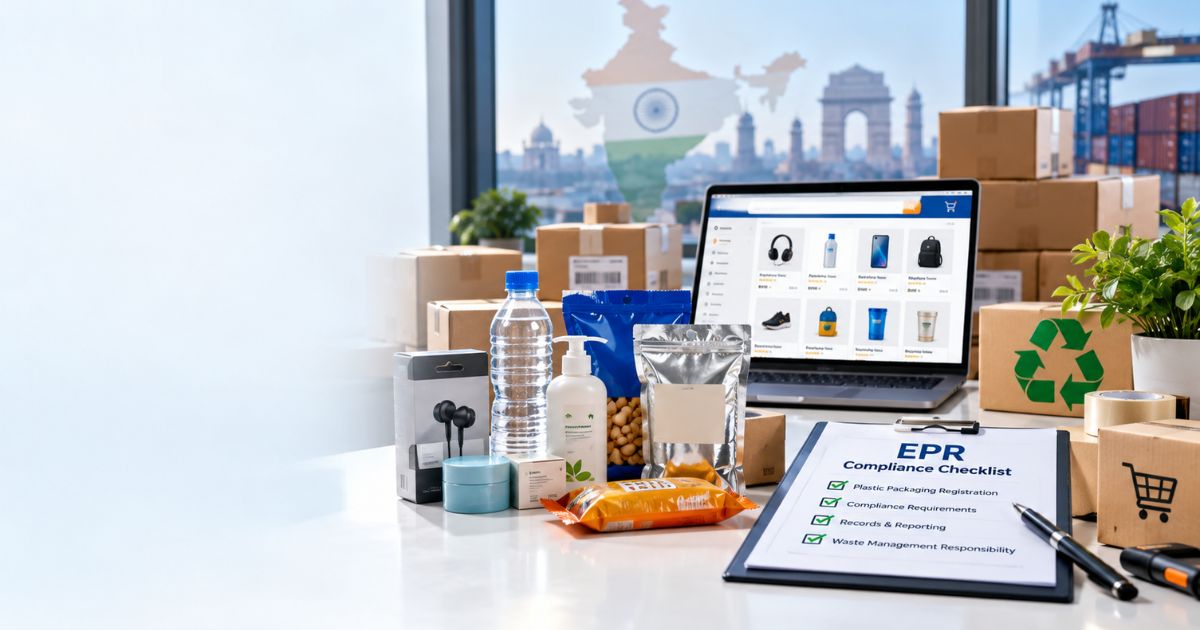
For importers selling products on Amazon and Flipkart, regulatory compliance can be easy to overlook while focusing on sourcing, logistics, listings, and sales. However, if your business places covered plastic packaging in the Indian market, understanding EPR registration for importers can be an important part of your compliance planning.
Extended Producer Responsibility (EPR) places responsibility on specified producers, importers, and brand owners for managing the waste associated with covered products or packaging. Under India's Plastic Waste Management framework, applicable Producers, Importers and Brand Owners (PIBOs) have obligations relating to plastic packaging waste.
For an importer selling through online marketplaces, the key question is not simply whether you sell on Amazon or Flipkart. It is whether your business and the packaging associated with your products fall within the applicable EPR framework.
What Is EPR for Importers?
Extended Producer Responsibility means that certain businesses have responsibility for the environmental management of waste generated from products or packaging they introduce into the market.
For plastic packaging, the framework covers Producers, Importers and Brand Owners. The CPCB's guidance provides for registration of applicable PIBOs through the EPR system.
An importer may therefore need to consider EPR obligations when importing products into India that are supplied with covered plastic packaging.
This can become particularly important for e-commerce sellers because products may be sold to consumers across multiple States and Union Territories.
Do Amazon and Flipkart Sellers Need EPR Registration?
Selling through Amazon or Flipkart does not, by itself, determine whether a seller requires plastic EPR registration.
The important factors include the seller's business role, the products being placed on the Indian market, the packaging involved, and whether the entity falls within the applicable definitions and exemptions.
For plastic packaging, CPCB's FAQ identifies Producers, Importers and Brand Owners as relevant entities. It also notes that Brand Owners can include online platforms or marketplaces and supermarkets/retail chains, subject to the applicable criteria.
Therefore, an importer should first determine its regulatory status instead of assuming that marketplace registration automatically satisfies EPR requirements.
EPR Registration for Amazon Sellers
For businesses researching EPR registration for Amazon sellers, the first step is to understand what is being imported and how it is packaged.
For example, an importer may bring a finished consumer product into India inside plastic packaging and then sell it through Amazon. Depending on the applicable rules and the business's role, the plastic packaging may create EPR obligations.
Amazon seller registration and environmental compliance are separate matters.
Having an Amazon seller account does not automatically mean that the seller has fulfilled applicable EPR obligations. Similarly, obtaining an EPR registration does not replace other registrations or licences that may be required for the business or product.
Sellers should therefore treat EPR as a separate compliance requirement and verify whether their specific activities fall within the applicable framework.
EPR Registration for Flipkart Sellers
The same principle applies to EPR registration for Flipkart sellers.
Flipkart is a sales channel. EPR obligations are determined by the applicable environmental rules and the role of the business.
An importer selling through Flipkart should examine:
- What products are being imported
- Whether plastic packaging is involved
- Who is responsible for the packaging
- Whether the business qualifies as an Importer or another regulated entity
- Where the business operates
- Whether any applicable exemption applies
- What EPR obligations arise from the quantity and category of packaging
This assessment should be completed before assuming that marketplace selling is either automatically covered or automatically exempt.
What Plastic Packaging Is Covered?
For businesses specifically dealing with plastic packaging, CPCB identifies four categories under the applicable EPR framework:
- Category I: Rigid plastic packaging
- Category II: Flexible plastic packaging, including certain single-layer and multilayer plastic packaging, sheets, covers, carry bags, sachets, and pouches
- Category III: Multilayered plastic packaging containing at least one layer of plastic and at least one layer of another material
- Category IV: Plastic sheets or similar material used for packaging and carry bags made from compostable plastics
The exact classification of packaging should be determined from the applicable regulatory definitions and the characteristics of the material.
CPCB EPR Registration: Who Should Apply?
The applicable registration authority can depend on the geographic scope of the business.
CPCB's current plastic EPR information states that PIBOs operating in more than two States/UTs are required to register with CPCB, while the applicable State Pollution Control Board or Pollution Control Committee handles registration for entities operating in one or two States/UTs, subject to the applicable framework.
This makes geographic operations an important consideration for e-commerce businesses.
An online seller should not assume that its registration authority is determined solely by the location of its registered office. The applicable rules and operational footprint should be examined carefully.
Documents Usually Required
The documentation required depends on the specific application, but CPCB's plastic EPR FAQ identifies key KYC information for PIBO registration.
These include documents such as:
- Company PAN
- CIN, where applicable
- GST information
- Authorized person's PAN
- Authorized person's Aadhaar
- Business and registration details
For proprietorship and partnership firms, CPCB's FAQ specifies PAN and GST information, while CIN applies to companies registered under the Companies Act.
Additional information relating to products, packaging, quantities, and the EPR action plan may also be required.
The CPCB guidance manual explains that registration involves providing company details, authorized-person information, and other application information through the EPR system.
Understanding the EPR Registration Process
The EPR registration process begins with determining whether the business is covered and identifying the appropriate regulatory category.
A practical process can be understood in these stages:
1. Identify the Business Role
Determine whether the business is acting as an Importer, Producer, Brand Owner, or another regulated entity.
2. Identify the Packaging
Review the packaging used with the imported products and determine whether it falls within the applicable plastic-packaging categories.
3. Collect Business Documents
Prepare the required company, tax, identification, and authorized-person documents.
4. Prepare Packaging and EPR Information
The application may require information relating to packaging materials, quantities, waste generation, and the proposed approach for fulfilling EPR obligations.
5. Submit the Application
The application is submitted through the applicable CPCB EPR system or competent authority, along with the required information and applicable fee.
6. Respond to Queries
If the authority identifies deficiencies or requests clarification, the applicant must provide the required response or documents.
7. Maintain Compliance
Registration is not necessarily the end of the process. Applicable entities may also have ongoing EPR obligations, including meeting targets and maintaining appropriate records and returns.
What Is an EPR Certificate for Amazon Sellers?
The term EPR certificate for Amazon sellers is often used broadly online, but sellers should understand that registration and EPR certificates are not necessarily the same thing.
For plastic packaging, the EPR framework includes mechanisms for fulfilling obligations through registered Plastic Waste Processors. CPCB's SOP states that PIBOs are required to fulfil EPR obligations by ensuring plastic waste is processed through registered PWPs and obtaining certificates from PWPs for the quantities processed to meet assigned targets.
Therefore, an importer should distinguish between:
EPR registration - establishing the entity's registration under the applicable framework.
EPR certificates/credits - documentation or credits associated with fulfilment of applicable EPR obligations.
The exact obligations depend on the applicable rules and the entity's category.
Important 2026 Portal Update
Businesses preparing a new application should pay attention to the current CPCB portal structure.
CPCB states that the earlier centralized Plastic EPR Portal was discontinued from 28 June 2026, and registered-user data was migrated to the newly developed Common EPR Portal. New updates and notifications are now directed through the Common EPR Portal.
This is important because older articles and guides may still direct applicants to the previous portal.
Before submitting an application, always verify the current portal and regulatory instructions from CPCB.
Common EPR Mistakes Made by Online Importers
E-commerce businesses can face avoidable compliance problems when they treat EPR as a simple registration form.
Common mistakes include:
- Assuming every online seller automatically needs the same EPR registration
- Failing to identify the correct business category
- Ignoring plastic packaging used with imported products
- Providing inconsistent company information
- Underestimating packaging quantities
- Using outdated portal instructions
- Treating registration as the end of compliance
- Failing to maintain records and fulfil applicable obligations
A proper compliance assessment before registration can help prevent many of these problems.
How Om Garuda Group Can Help
At Om Garuda Group, we help businesses understand and manage regulatory and certification requirements in India.
For importers selling through Amazon, Flipkart, and other e-commerce channels, our approach starts with understanding the business model, products, packaging, and applicable regulatory requirements.
Rather than treating every seller as having the same compliance requirements, the focus should be on identifying the correct EPR category, preparing the required information, supporting the registration process, and helping businesses understand their continuing obligations.
For an importer entering the Indian market or an existing e-commerce seller expanding its product range, getting the compliance structure right early can help reduce unnecessary delays and regulatory risks.
Final Thoughts
EPR compliance is an important consideration for importers selling products in India, particularly when covered plastic packaging is involved.
If you are researching EPR registration in India, do not start by asking only which marketplace you sell on. Start by asking what you import, how it is packaged, what role your business performs under the applicable rules, and where you operate.
For Amazon and Flipkart sellers, marketplace activity is only one part of the picture.
Understanding the applicable EPR framework, identifying the correct registration authority, preparing accurate documentation, and fulfilling ongoing obligations can help your business remain compliant as it grows.
If you are unsure whether your imported products and packaging create EPR obligations, a product-specific regulatory assessment can help you determine the appropriate next step.