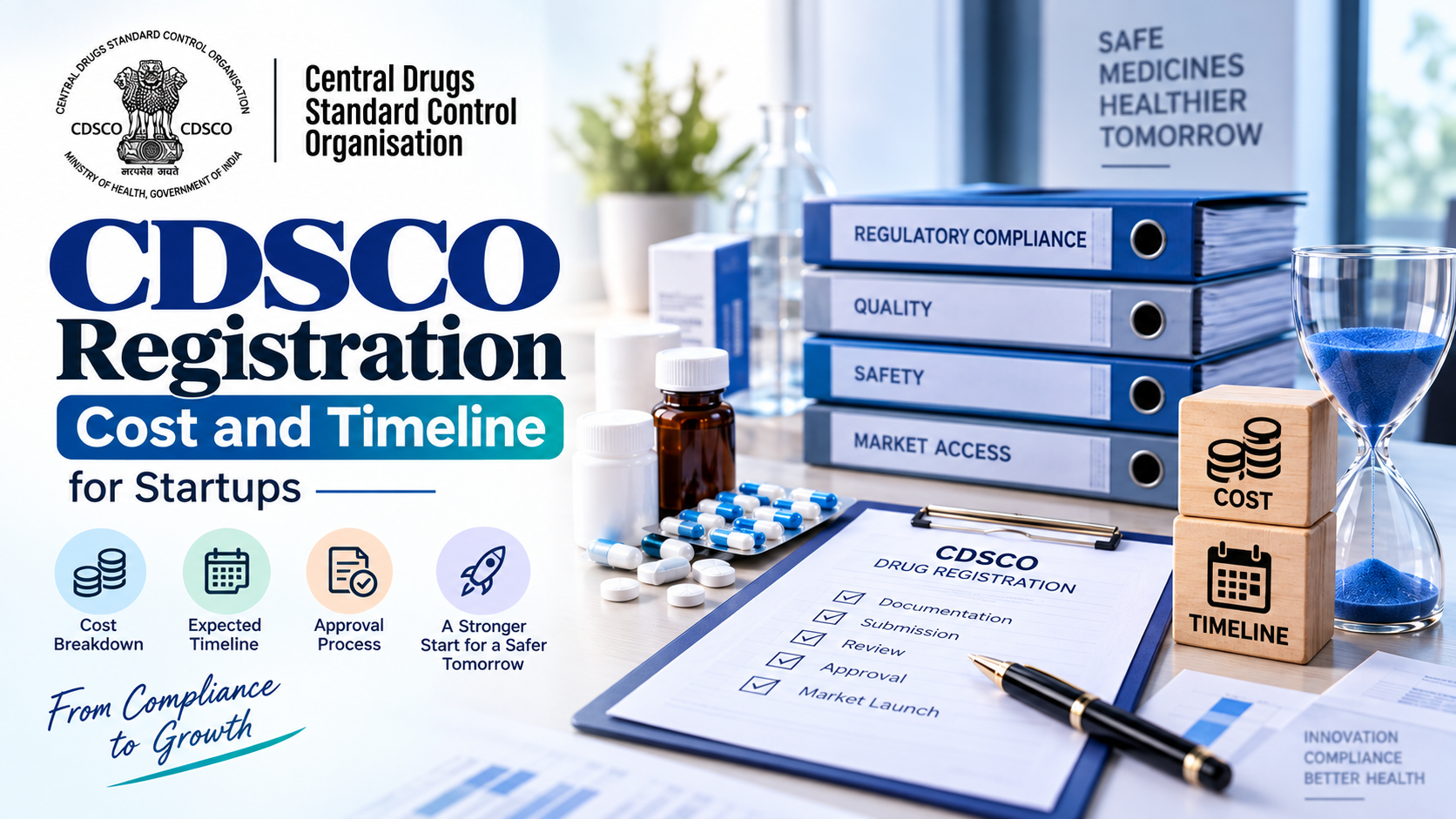
For startups planning to manufacture, import, or market regulated products in India, understanding the CDSCO registration cost is an important part of business planning. However, there is no single fee or timeline that applies to every business. The actual cost and approval period depend on the product category, regulatory pathway, application type, documents, and whether additional approvals or testing are required.
The Central Drugs Standard Control Organisation (CDSCO) regulates various categories of products in India, including drugs, cosmetics, and medical devices. Therefore, before estimating the budget or timeline, a startup first needs to determine which regulatory requirements apply to its specific product.
This guide explains the major factors that influence CDSCO registration costs, what startups generally need to prepare, how the process works, and why applications can sometimes take longer than expected.
What Is CDSCO Registration?
CDSCO is India's national regulatory authority for pharmaceuticals, medical devices, cosmetics, and certain other products under the applicable laws and rules.
Depending on the product and activity, a business may need to obtain an applicable registration, licence, import-related approval, or other regulatory permission.
This means that CDSCO registration in India is not one universal registration process.
For example, the requirements for importing a medical device are different from those for registering imported cosmetics. Similarly, drug-related applications can involve different forms, licences, and documentation depending on the product and proposed activity.
The first step for any startup is therefore to identify the correct regulatory category.
How Much Does CDSCO Registration Cost?
One of the most common questions from new businesses is: “How much does CDSCO registration cost?”
The answer depends on the specific application.
The overall expense may include several components, such as:
- Applicable government or statutory fees
- Product or application-specific charges
- Testing or laboratory costs, where required
- Documentation and compliance expenses
- Professional consultancy fees
- Translation, notarization, or legalization costs where applicable
- Costs associated with responding to regulatory queries
Therefore, a startup should not assume that the government application fee represents the total cost of obtaining approval.
The CDSCO license cost in India can vary significantly depending on the product category, number of products, manufacturing or import arrangement, and regulatory route.
Before budgeting, businesses should identify the exact application and applicable fee schedule rather than relying on a generic online estimate.
What Factors Affect CDSCO Registration Cost?
Several factors can influence the final cost.
1. Product Category
The first and most important factor is the type of product.
Drugs, medical devices, cosmetics, and other regulated products can have different regulatory requirements.
2. Import or Manufacturing Activity
A startup importing a product may follow a different regulatory route from a company manufacturing the product in India.
The responsible applicant, manufacturing location, product classification, and supporting documents can all affect the application.
3. Number of Products
The number of products or variants included in an application can influence documentation, fees, testing, and review requirements.
4. Testing Requirements
Certain products may require testing, reports, or other technical evidence depending on the applicable regulations.
5. Documentation
If documents originate outside India, additional formalities such as notarization, authentication, legalization, or other document requirements may apply depending on the specific application.
For this reason, preparing the documentation correctly from the beginning can help reduce unnecessary delays and additional expenses.
CDSCO Registration Requirements for Startups
Before starting the application, a startup should understand the CDSCO registration requirements applicable to its product.
Although requirements vary, applicants may need information and documents relating to areas such as:
- Applicant or company details
- Product details
- Manufacturer information
- Manufacturing site details
- Product specifications
- Labels and packaging information
- Technical documentation
- Certificates or supporting documents
- Testing or quality-related reports, where applicable
- Authorization documents for representatives or applicants, where required
The exact list should always be confirmed against the current regulatory requirements for the particular product.
One of the biggest mistakes startups make is collecting documents based on a general checklist found online without first confirming the applicable product category.
CDSCO Registration Process: Step by Step
The CDSCO registration process generally begins with identifying the applicable regulatory pathway and preparing the required documentation.
Step 1: Identify the Product Category
Determine whether the product falls under drugs, medical devices, cosmetics, or another regulated category.
For medical devices, classification and risk category can be particularly important because regulatory requirements may differ according to the device classification.
Step 2: Determine the Applicable Regulatory Route
Once the product is classified, identify the appropriate application, licence, registration, or permission.
This is where professional regulatory guidance can be useful, particularly for startups entering the Indian market for the first time.
Step 3: Prepare the Documentation
Gather company, manufacturer, product, technical, quality, and other supporting documents required for the specific application.
Documents should be consistent across the application. Differences in company names, addresses, product descriptions, or manufacturer details can create avoidable queries.
Step 4: Submit the Application
The relevant application is submitted through the applicable CDSCO regulatory system or process, along with the required documents and fees.
For certain applications, CDSCO uses the SUGAM online portal.
Step 5: Regulatory Review
The submitted information is reviewed by the appropriate authority.
The regulator may request clarification, additional documentation, or corrections if the application does not contain sufficient or consistent information.
Step 6: Respond to Queries
If a query is raised, the applicant must respond with the required information within the applicable timeframe.
A clear and complete response can help prevent unnecessary back-and-forth.
Step 7: Approval or Further Action
If the application satisfies the applicable requirements, the relevant registration, licence, or approval may be issued.
The exact outcome depends on the regulatory pathway and application type.
How Long Does CDSCO Registration Take?
The CDSCO registration for startups timeline is another area where businesses should avoid relying on a single fixed number.
Processing time can depend on:
- Product category
- Application type
- Completeness of documents
- Regulatory classification
- Testing requirements
- Foreign manufacturer documentation
- Regulatory queries
- Corrections or resubmissions
- Current workload and review requirements
A complete and correctly prepared application is generally easier to process than one that requires repeated clarification.
For this reason, startups should build some contingency time into their launch plans instead of scheduling a product launch based on an assumed approval date.
Common Reasons for CDSCO Delays
A significant portion of avoidable delays can come from documentation and preparation issues.
Common problems include:
Incomplete documentation
Missing documents can result in queries or requests for additional information.
Incorrect product classification
If the regulatory category is misunderstood at the beginning, the business may need to revise its approach later.
Inconsistent information
Company names, addresses, manufacturer details, product names, and other information should be consistent across submitted documents.
Poor-quality technical documents
Incomplete or unclear technical information can make regulatory review more difficult.
Last-minute preparation
Waiting until the planned launch date is approaching can create unnecessary pressure if additional requirements arise.
How Startups Can Prepare Before Applying
Startups can make the process more manageable by preparing a regulatory checklist before submission.
Begin by identifying:
- What is the exact product?
- Which regulatory category applies?
- Is the business importing or manufacturing?
- Who is the legal applicant?
- Which manufacturer is involved?
- What technical documents are required?
- Are testing or certificates required?
- What fees apply to the specific application?
- What is the expected regulatory timeline?
- What contingency time is available?
This approach allows regulatory planning to become part of the product launch strategy rather than an afterthought.
Should a Startup Hire a CDSCO Consultant?
For straightforward applications, a business with suitable internal regulatory expertise may be able to manage the process itself.
However, startups that are unfamiliar with Indian regulatory procedures may benefit from professional assistance.
A regulatory consultant can help with product classification, documentation, application preparation, submission, query responses, and compliance planning.
The value is not simply in submitting a form. Proper preparation can help identify potential problems before submission and reduce avoidable errors.
How Om Garuda Group Can Help
At Om Garuda Group we help businesses understand and navigate regulatory and certification requirements in India.
For startups dealing with regulated products, the first step is understanding the applicable approval pathway rather than assuming that every product follows the same CDSCO procedure.
Our approach focuses on understanding the product, identifying the relevant requirements, preparing the necessary documentation, and supporting the application process.
Whether you are a startup entering the Indian market, an importer, manufacturer, or an established business expanding its product portfolio, regulatory preparation can make the approval process more structured and predictable.
Final Thoughts
Understanding the CDSCO registration cost and timeline is important for every startup working with regulated products, but there is no universal price or processing period.
The actual requirements depend on the product category, regulatory pathway, application type, documentation, testing, and other factors.
The safest approach is to identify the correct regulatory route first, confirm the applicable fees and requirements, prepare complete documentation, and allow sufficient time for regulatory review and possible queries.
For startups, good regulatory planning is not just about obtaining an approval. It can help prevent avoidable delays, unexpected expenses, and problems during product launch.
If you are unsure which CDSCO pathway applies to your product, obtaining professional regulatory guidance before submitting the application can help you start the process with greater clarity.