
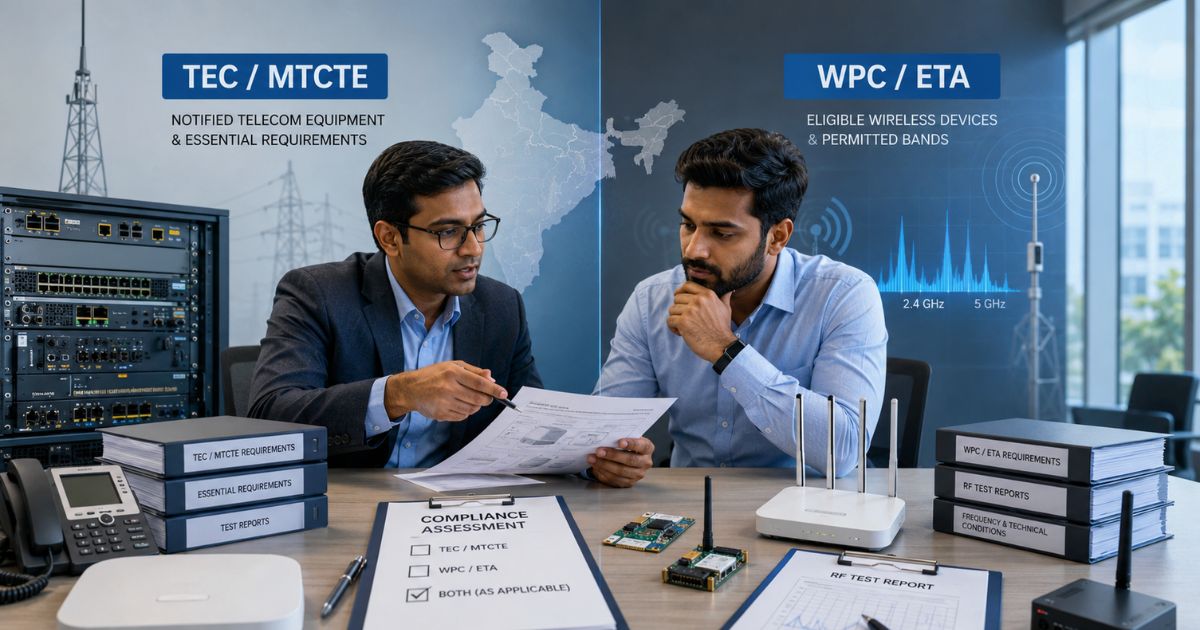
Launching a telecom or wireless product in India involves more than developing a reliable device. Businesses must also understand the regulatory approvals required before the product can be legally marketed, sold, or deployed. One common question is TEC vs WPC certification, which one does your product actually need?
The answer depends largely on what your product does. TEC's MTCTE framework focuses on specified telecom equipment and its compliance with applicable Essential Requirements, while WPC ETA is relevant to eligible wireless devices operating in permitted de-licensed frequency bands. In some cases, a product may need to comply with requirements from both regulatory frameworks.
Understanding the difference early can help manufacturers, importers, and technology companies avoid unnecessary delays and choose the appropriate compliance route.
What Is TEC Certification?
TEC certification is associated with the Telecommunication Engineering Centre (TEC), a technical body under the Department of Telecommunications (DoT), Government of India.
TEC administers the Mandatory Testing and Certification of Telecommunication Equipment (MTCTE) framework for notified telecom equipment.
Under MTCTE, applicable telecom equipment must conform to the prescribed Essential Requirements and undergo the relevant conformity assessment before it can be sold, deployed, or used in India.
The objective is to ensure that covered telecom products meet specified technical, safety, and performance requirements.
The exact requirements depend on the product category and the Essential Requirements applicable to that equipment.
What Is MTCTE Certification?
MTCTE certification is the certification route used for telecom equipment covered by India's mandatory testing and certification framework.
TEC maintains product-specific requirements and testing procedures for equipment covered under MTCTE.
Depending on the equipment, compliance may involve testing at designated or recognized laboratories and submission of the required application and supporting documentation.
The important point for manufacturers and importers is that not every electronic device automatically falls under MTCTE. The product must first be checked against the applicable notified equipment categories and requirements.
What Is WPC Certification?
WPC certification generally refers to approvals associated with the Wireless Planning & Coordination Wing of DoT.
For eligible wireless products, the commonly relevant approval is WPC ETA certification, where ETA means Equipment Type Approval.
WPC ETA is particularly relevant to wireless devices that operate in frequency bands permitted for use without an individual frequency assignment, subject to the applicable conditions.
Examples can include certain products using technologies such as Wi-Fi, Bluetooth, and other short-range wireless communication technologies.
However, simply having a wireless function does not mean that every device follows exactly the same regulatory route. The frequency, technology, transmission characteristics, product configuration, and applicable rules need to be considered.
What Is WPC ETA Certification?
WPC ETA certification is an approval route for eligible wireless devices operating in permitted de-licensed frequency bands.
According to DoT's current service information, ETA is a self-declaration-based process for eligible wireless devices. The applicant submits the required information and supporting documents, including relevant RF test reports, through the applicable DoT process.
The exact requirements depend on the type of wireless equipment and the applicable frequency and technical conditions.
This is why manufacturers and importers should evaluate the wireless characteristics of a product before deciding whether WPC ETA is required.
TEC vs WPC: What Is the Difference?
The easiest way to understand TEC vs WPC certification is to look at what each framework primarily addresses.
|
Factor |
TEC / MTCTE |
WPC / ETA |
|
Regulatory body |
Telecommunication Engineering Centre |
Wireless Planning & Coordination Wing |
|
Parent department |
Department of Telecommunications |
Department of Telecommunications |
|
Primary focus |
Notified telecom equipment |
Eligible wireless/RF equipment |
|
Main route |
MTCTE conformity assessment |
Equipment Type Approval |
|
Key consideration |
Applicable Essential Requirements |
Wireless frequency and RF characteristics |
|
Testing |
Product-specific testing as prescribed |
Relevant RF/test documentation as applicable |
|
Applicability |
Notified telecom equipment |
Eligible wireless devices using permitted bands |
The two should not be treated as interchangeable certificates.
A telecom device can fall under one framework, the other, or potentially both depending on its functionality and the applicable regulatory requirements.
Which Products May Need MTCTE?
The applicability of MTCTE depends on whether the equipment falls within the notified categories.
Examples of telecom equipment that may come under the framework can include certain network, transmission, access, or terminal equipment.
However, the exact applicability should always be verified against the latest TEC notifications and Essential Requirements.
For businesses, the safest approach is to identify the product category first rather than assuming that a product requires MTCTE simply because it connects to a network.
Which Products May Need WPC ETA?
WPC requirements are particularly relevant when a product contains wireless or RF transmission functionality.
Depending on the product, this may include devices using technologies such as:
- Wi-Fi
- Bluetooth
- Certain RFID applications
- Short-range wireless communication
- Other RF-based communication technologies
The specific frequency band and operating parameters matter.
A wireless product operating in a permitted de-licensed band may be eligible for ETA, while products involving other spectrum requirements may require additional regulatory consideration.
Therefore, WPC certification for wireless products should always be assessed based on the actual RF characteristics rather than the product's marketing name.
Can a Product Need Both TEC and WPC?
Yes, potentially.
This is one of the most important points businesses should understand.
Suppose a telecom product performs a function covered by MTCTE and also contains a wireless communication module. The product may have obligations under both regulatory frameworks, depending on the applicable requirements.
For example, a network device with integrated Wi-Fi functionality could require assessment under the applicable TEC requirements while its wireless functionality may also require WPC-related approval.
This does not mean every product with Wi-Fi automatically needs both.
The correct approach is to assess:
- The product's primary function
- Telecom functionality
- Wireless/RF functionality
- Frequency bands used
- Applicable TEC notifications
- Applicable WPC requirements
- Product configuration and modules
- Current regulatory requirements
MTCTE Certification Process: Step by Step
The MTCTE certification process generally involves several stages.
1. Identify the Product Category
Determine whether the equipment falls under a notified MTCTE category.
2. Review Essential Requirements
Identify the applicable technical and regulatory requirements for the product.
3. Select the Appropriate Testing Route
Testing should be performed according to the prescribed requirements and through the applicable recognized or designated laboratory route.
4. Prepare Documentation
The application may require product specifications, technical information, test reports, manufacturer details, and other supporting documents.
5. Submit the Application
The applicant submits the required information through the applicable TEC certification system.
6. Address Queries
If TEC or the relevant authority identifies an issue or requests clarification, the applicant must provide the necessary response or documentation.
7. Obtain Certification
Once the applicable conformity requirements are satisfied, the relevant certificate can be issued.
The exact process and documentation can vary according to the equipment category.
WPC ETA Process
The WPC ETA process also begins with product and RF assessment.
A typical process includes:
- Identifying the wireless technology
- Checking the operating frequency
- Reviewing applicable de-licensed frequency conditions
- Obtaining the relevant RF test report
- Preparing applicant and product documents
- Submitting the application through the applicable DoT process
- Responding to queries, if any
- Obtaining the ETA where the product satisfies the requirements
Businesses should use current DoT instructions because regulatory processes and portal requirements can change.
Common Compliance Mistakes
Manufacturers and importers often encounter problems when they treat regulatory approval as a generic certification exercise.
Common mistakes include:
- Assuming TEC and WPC are the same certification
- Assuming every wireless product automatically needs the same approval
- Ignoring the product's exact frequency characteristics
- Failing to check current MTCTE notifications
- Using outdated test reports or documentation
- Providing inconsistent manufacturer information
- Selecting the wrong product category
- Starting the application without reviewing the complete regulatory pathway
These mistakes can result in additional queries, rework, and delays in product launch.
How to Determine Which Certification You Need
Before applying, create a simple regulatory assessment for the product.
Ask:
Does the product fall under a notified telecom equipment category?
If yes, examine the applicable MTCTE requirements.
Does the product transmit or communicate wirelessly?
If yes, examine the applicable WPC/ETA requirements.
Does it involve both telecom and wireless functionality?
If yes, assess whether requirements under both frameworks apply.
This product-level assessment is much more reliable than selecting a certificate based only on the product name.
How Om Garuda Group Can Help
At Om Garuda Group, we help manufacturers, importers, and businesses understand regulatory and certification requirements for products entering the Indian market.
For businesses researching telecom product certification in India, identifying the correct compliance route is an important first step.
Our support can include understanding the product and its technical characteristics, identifying applicable certification requirements, organizing documentation, coordinating testing and applications, and assisting with regulatory queries.
Whether you need to understand MTCTE certification, TEC certification, WPC certification, or WPC ETA certification, the right approach begins with assessing the actual product rather than choosing a certification based on assumptions.
Final Thoughts
TEC and WPC serve different regulatory purposes, and understanding the distinction can save manufacturers and importers considerable time.
TEC/MTCTE primarily addresses notified telecom equipment and conformity with applicable Essential Requirements. WPC ETA focuses on eligible wireless devices and their use of permitted frequency bands.
The key takeaway is that there is no universal “TEC or WPC” answer for every telecom product. Depending on its functionality, a device may fall under one framework or potentially require compliance with both.
Before launching a telecom or wireless product in India, review its technical specifications, telecom functions, wireless technologies, frequency bands, and applicable regulatory notifications.
Getting the regulatory assessment right at the beginning can help businesses avoid unnecessary delays and move toward market entry with greater confidence.