
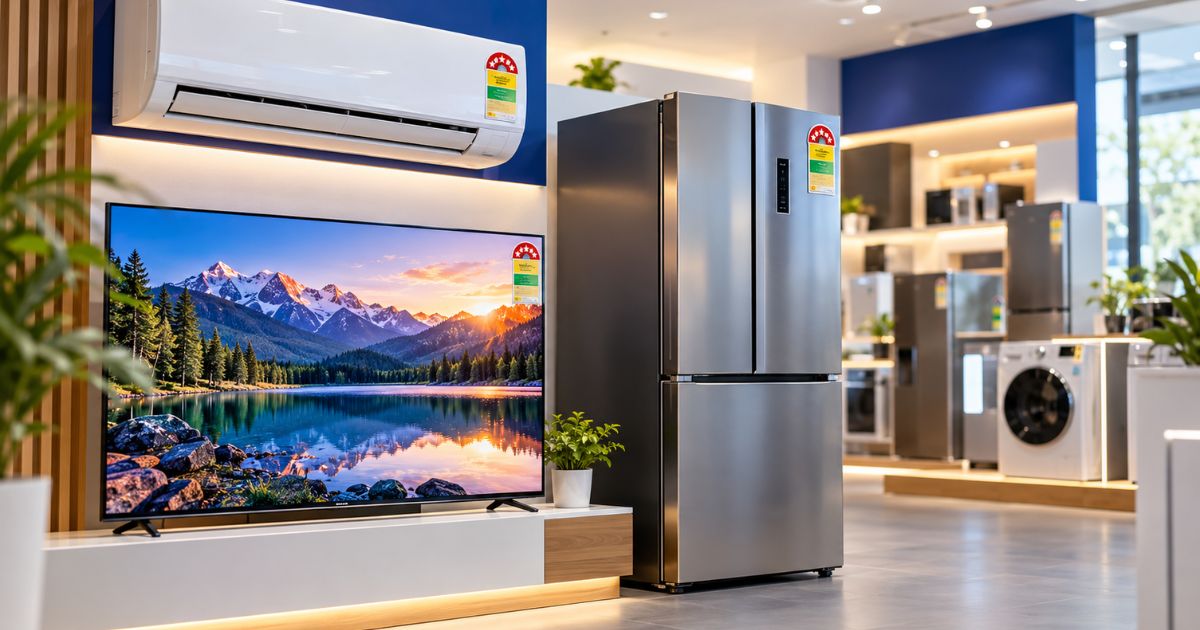
When customers compare energy-consuming appliances, the BEE star rating is often one of the first things they notice. From 1 to 5 stars, the label helps buyers quickly compare energy efficiency and potential running costs. For manufacturers and brands, it can also influence product appeal, consumer trust, and purchasing decisions.
But what does a BEE rating actually mean, and how can it affect your product sales? Let’s break down the rating, certification requirements, and its impact on the market.
What Is a BEE Star Rating?
A BEE star rating communicates the energy performance of a covered appliance or equipment through a standardized label.
The rating generally ranges from 1 Star to 5 Stars, with 5 Star indicating the higher energy-efficiency performance under the applicable BEE criteria. However, the specific performance metric used to determine the rating varies by product category. For example, BEE notes that annual energy consumption is used for products such as refrigerators and televisions, while air conditioners use parameters such as ISEER.
This distinction is important because a star rating should not be interpreted as a universal percentage of energy savings across every type of appliance.
Instead, consumers should compare products within the same category and consider the energy information displayed on the applicable label.
Why Does the BEE Rating Matter to Consumers?
Energy efficiency can influence the total cost of owning an appliance.
A product with better energy performance may help reduce electricity consumption during its operating life, depending on how it is used. This makes the energy label useful when consumers are comparing products with similar functions.
BEE describes its Standards & Labelling programme as a way to help consumers make informed decisions about energy savings and the cost-saving potential of energy-consuming appliances.
For a consumer, the decision may therefore involve more than the initial purchase price.
A lower-priced appliance may appear attractive at first, but buyers may also consider electricity consumption, expected usage, product features, and long-term operating costs.
What Are the BEE Star Rating Benefits for Businesses?
There are several potential BEE star rating benefits for manufacturers and brands.
Better product comparison
A standardized energy label gives consumers an easy way to compare products within the relevant category.
Stronger value proposition
Energy-efficient products can appeal to customers who are concerned about electricity costs and long-term ownership expenses.
Greater consumer awareness
The label provides information that consumers can use alongside price, features, warranty, design, and other purchasing factors.
Market differentiation
When several products offer similar features, energy performance can become one of the factors that differentiates competing products.
However, businesses should avoid treating a higher star rating as a guarantee of higher sales. Purchasing decisions are influenced by many factors, including price, product quality, brand reputation, features, availability, and consumer preferences.
How BEE Star Rating Affects Sales
So, how BEE star rating affects sales is a more nuanced question than simply saying that a higher rating always increases sales.
For energy-consuming appliances, the label can influence the customer's perception of running costs and efficiency. A consumer who expects to use an appliance frequently may place greater importance on energy performance than someone whose usage is limited.
For example, imagine two comparable appliances with similar features. If one has stronger energy-efficiency performance and the difference in purchase price is acceptable to the customer, the efficiency information may contribute to the purchase decision.
This can be particularly relevant for products that consume significant amounts of electricity over long periods.
However, businesses should communicate energy performance accurately and avoid unsupported claims about guaranteed savings.
Is BEE Certification Mandatory for Every Appliance?
No. This is an important point for manufacturers and importers.
BEE's Standards & Labelling programme includes both mandatory and voluntary product categories. The applicable requirement depends on the product and the relevant regulations or notifications. BEE's current programme information lists multiple appliances and equipment under the S&L framework and distinguishes mandatory from voluntary labelling.
Therefore, a business should not assume that every electrical or energy-consuming product must carry a BEE star label.
Before starting an application, the manufacturer or importer should verify whether the specific product category is covered and whether the applicable labelling regime is mandatory or voluntary.
BEE Certification for Appliances: What Businesses Should Know
The phrase BEE certification for appliances is commonly used to describe the process of obtaining approval to participate in the applicable Standards & Labelling programme.
Technically, businesses should focus on the requirements applicable to their particular product category.
The process can involve product testing, technical information, manufacturer or brand details, application documentation, and compliance with the relevant BEE regulations or schedule.
BEE also conducts check testing to verify whether products continue to meet the performance claims made on their labels. The Bureau states that check testing is used to ensure that product models meet the performance claims on the label.
This means that businesses should not treat registration as a one-time paperwork exercise. The product must continue to conform to the applicable requirements.
Understanding BEE Registration for Products
Businesses researching BEE registration for products should first identify the exact product category.
The process may differ depending on the equipment involved and the applicable S&L requirements.
A practical starting checklist includes:
- Identify the exact product category.
- Check whether the product falls under mandatory or voluntary labelling.
- Review the applicable BEE regulation or schedule.
- Identify the required technical parameters.
- Arrange testing through the appropriate laboratory, where required.
- Prepare manufacturer and brand information.
- Collect technical and supporting documents.
- Submit the application through the applicable BEE system.
- Respond to regulatory queries, if raised.
- Follow the applicable label display and compliance requirements.
The details should always be checked against the current BEE requirements for the particular product rather than relying on a generic checklist.
What Information Appears on a BEE Label?
A BEE label can contain important information that helps consumers understand the product's energy performance.
BEE's FAQ explains that the label can include information such as the relevant energy-performance parameter, brand and model details, technical parameters, label period or validity, manufacturing year, and a unique series code.
The exact information can vary according to the product category.
For businesses, accuracy is essential because the information presented to consumers needs to correspond with the approved product and applicable requirements.
Does a 5-Star Rating Always Mean the Product Is Better?
Not necessarily.
A 5-Star product indicates stronger energy-efficiency performance under the applicable rating criteria, but energy efficiency is only one part of product quality.
Consumers may also consider:
- Purchase price
- Product capacity
- Features
- Durability
- Warranty
- After-sales service
- Brand reputation
- Maintenance requirements
- Actual usage patterns
For example, a consumer who rarely uses an appliance may place less emphasis on energy consumption than a household that operates the same type of appliance for many hours each day.
Therefore, businesses should present the BEE rating as one meaningful product benefit rather than claiming that it automatically makes a product superior in every respect.
How Brands Can Use Energy Efficiency in Marketing
Once a product has an applicable BEE rating, businesses can incorporate accurate energy-performance information into their product communication.
Useful approaches include:
Explain the benefit
Instead of simply displaying the star count, explain why energy performance matters to the customer.
Focus on long-term value
Where appropriate, show how energy consumption can affect operating costs without making unsupported savings claims.
Keep claims accurate
Marketing material should match the approved label and applicable technical information.
Educate customers
Simple explanations can help customers understand what the rating means and how to compare similar products.
Combine efficiency with other benefits
Energy performance can be presented alongside durability, features, warranty, design, and service to create a more complete value proposition.
Common BEE Compliance Mistakes
Manufacturers and importers can encounter problems when they treat BEE requirements as a generic certification process.
Common mistakes include:
- Assuming every product requires mandatory star labelling
- Using outdated regulatory information
- Selecting the wrong product category
- Providing inconsistent product or brand information
- Using incorrect technical or energy-performance information
- Treating testing and documentation as an afterthought
- Making marketing claims that go beyond approved information
- Failing to monitor applicable label validity or regulatory updates
Because BEE periodically updates standards, schedules, and programme requirements, businesses should verify the current rules before applying.
How Om Garuda Group Can Help
At Om Garuda Group, we help businesses navigate regulatory and certification requirements for products entering and operating in the Indian market.
For manufacturers and importers exploring BEE certification for appliances, the first step is determining whether the specific product is covered under the Standards & Labelling programme and identifying the applicable regulatory route.
Our support can include understanding the applicable requirements, organizing documentation, coordinating the certification process, and helping businesses address compliance-related requirements.
For companies launching a new appliance, importing an energy-consuming product, or expanding an existing product range, getting the compliance process right early can help reduce avoidable delays and documentation issues.
Final Thoughts
The BEE label is designed to make energy-performance information easier for consumers to understand and compare. For businesses, that information can become an important part of product positioning, especially in categories where electricity consumption contributes significantly to ownership costs.
A higher star rating can support a product's value proposition, but it should not be treated as a guaranteed sales driver. Price, features, quality, brand trust, service, and customer needs all continue to influence purchasing decisions.
For manufacturers and importers, the priority should be to understand the applicable BEE requirements, complete testing and documentation accurately, use the correct label, and maintain compliance with the relevant regulations.
If your business is unsure whether your product requires BEE registration or what steps apply to your category, professional guidance can help you identify the appropriate route before you invest time and resources in the application.