
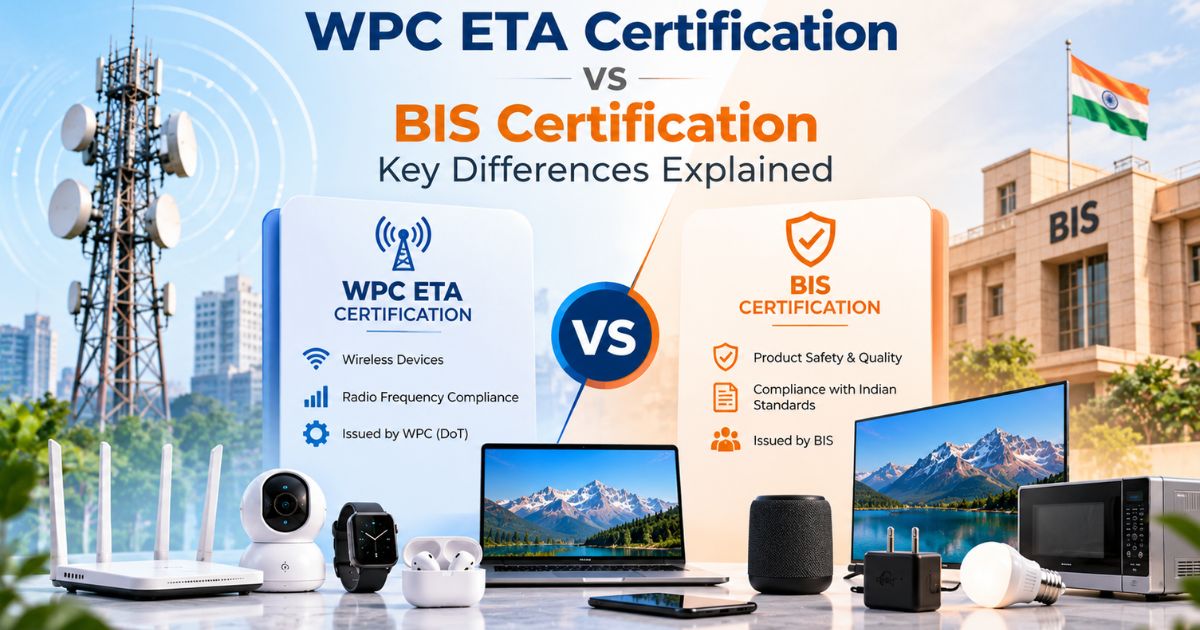
If you're planning to manufacture, import, or sell electronic products in India, you've probably come across two important regulatory requirements - WPC ETA Certification and BIS Certification. While both are mandatory for many electronic products, they serve entirely different purposes and are issued by different government authorities.
Understanding the WPC ETA Certification vs BIS Certification difference is essential because applying for the wrong certification can delay product launches, increase compliance costs, and even lead to customs clearance issues.
In this guide, we'll explain the Difference Between WPC ETA and BIS Certification, when each certification is required, and whether your product needs one or both.
What is WPC ETA Certification?
WPC ETA Certification is issued by the Wireless Planning & Coordination (WPC) Wing under the Department of Telecommunications (DoT), Government of India.
The purpose of this certification is to ensure that wireless and radio frequency devices operate only on approved frequency bands in India. Products using license-exempt frequency bands must obtain Equipment Type Approval (ETA) before they can be imported or sold.
Products that commonly require WPC Certification for Wireless Devices include:
- Wi-Fi routers
- Bluetooth speakers
- Wireless keyboards and mice
- Smartwatches
- Wireless CCTV cameras
- RFID devices
- Zigbee and LoRa devices
- IoT products with wireless communication
Obtaining WPC ETA Approval in India demonstrates that the wireless module complies with India's radio frequency regulations.
What is BIS Certification for Electronics?
BIS Certification for Electronics is regulated by the Bureau of Indian Standards (BIS) under the Compulsory Registration Scheme (CRS).
Unlike WPC approval, BIS certification focuses on product safety, quality, and compliance with applicable Indian Standards. It ensures that electronic products sold in India meet prescribed safety requirements and do not pose risks to consumers.
Products commonly requiring BIS CRS Certification include:
- LED televisions
- Mobile phones
- Laptops
- Power adapters
- LED lighting products
- Smart speakers
- Microwave ovens
- UPS systems
- IT equipment
- Electronic appliances covered under the CRS scheme
Manufacturers must complete product testing through BIS-recognized laboratories before registration is granted.
WPC ETA Certification vs BIS Certification
Although both certifications apply to electronic products, they regulate different aspects of compliance.
|
Parameter |
WPC ETA Certification |
BIS Certification |
|
Purpose |
Radio frequency compliance |
Product safety and quality |
|
Authority |
Wireless Planning & Coordination (DoT) |
Bureau of Indian Standards (BIS) |
|
Applicable Products |
Wireless devices |
Electronic products under CRS |
|
Testing Focus |
RF frequency compliance |
Safety and performance testing |
|
Mandatory |
Yes, for eligible wireless products |
Yes, for notified electronic products |
|
Certification Type |
Equipment Type Approval |
BIS CRS Registration |
This comparison clearly explains the Difference Between WPC ETA and BIS Certification and why businesses often need to comply with both.
WPC vs BIS Certification in India: Which Products Need Both?
Many modern electronic products combine wireless technology with electrical components. In such cases, both certifications become mandatory.
Examples include:
- Smartphones
- Smart TVs
- Wireless printers
- Smart home devices
- Smartwatches
- Bluetooth-enabled appliances
- Wi-Fi security cameras
- Wireless payment terminals
For example, a Bluetooth speaker requires WPC ETA Certification because it transmits radio signals, while it may also require BIS Certification for Electronics if it falls under the notified CRS category.
This is why understanding WPC vs BIS Certification in India is important before importing or manufacturing products.
Do I Need WPC or BIS Certification?
One of the most common questions businesses ask is, "Do I Need WPC or BIS Certification?"
The answer depends entirely on your product's functionality.
You generally need WPC ETA Certification if your product:
- Uses Wi-Fi
- Uses Bluetooth
- Operates on RF frequencies
- Includes wireless communication modules
You generally need BIS CRS Certification if your product:
- Appears under the BIS Compulsory Registration Scheme
- Falls within notified electronic product categories
- Must comply with Indian safety standards
Some products require only one certification, while others require both. Checking the applicable regulations before import or manufacturing helps avoid delays and penalties.
Key Differences Between WPC ETA and BIS Certification
Here are the major differences businesses should understand:
Regulatory Objective
WPC approval regulates radio spectrum usage, whereas BIS certification regulates product safety and quality.
Issuing Authority
WPC ETA Approval is issued by the Department of Telecommunications through the WPC Wing. BIS registration is granted by the Bureau of Indian Standards.
Product Scope
Wireless Product Certification in India mainly covers devices with wireless communication technology.
BIS certification covers a broader range of electronic and electrical products listed under the CRS scheme.
Testing Requirements
WPC approval primarily evaluates wireless frequency parameters and supporting RF documents.
BIS certification requires laboratory testing according to applicable Indian Standards before registration.
Compliance Focus
WPC ensures that wireless devices do not interfere with licensed communication networks.
BIS ensures electronic products meet safety, reliability, and performance requirements.
Why Compliance Matters
Failure to obtain the required certification can create serious business problems, including:
- Customs clearance delays
- Import rejection
- Product seizure
- Legal penalties
- Market withdrawal
- Loss of customer trust
Proper compliance ensures smoother imports, uninterrupted sales, and regulatory confidence in the Indian market.
How Om Garuda Group Can Help
Navigating multiple regulatory approvals can be challenging, especially when products require both WPC ETA Certification and BIS CRS Certification.
Om Garuda Group assists manufacturers, importers, exporters, and brand owners with end-to-end certification support, including:
- Product eligibility assessment
- Documentation preparation
- Coordination with accredited testing laboratories
- WPC ETA application assistance
- BIS CRS registration support
- Compliance guidance for imported products
- End-to-end regulatory consultation
Working with experienced compliance professionals helps businesses reduce delays, avoid documentation errors, and obtain approvals more efficiently.
Conclusion
Understanding WPC ETA Certification vs BIS Certification is essential for anyone involved in manufacturing or importing electronic products into India. Although both certifications apply to electronic devices, they regulate different compliance areas. WPC focuses on wireless frequency approval, while BIS ensures product safety and quality.
Before launching any electronic or wireless product, determine whether it requires WPC ETA Certification, BIS Certification for Electronics, or both. Taking the correct compliance route from the beginning helps avoid costly delays and ensures smooth market entry.
If you're unsure which certification applies to your product, Om Garuda Group can help you identify the applicable regulations and guide you through the complete certification process.