
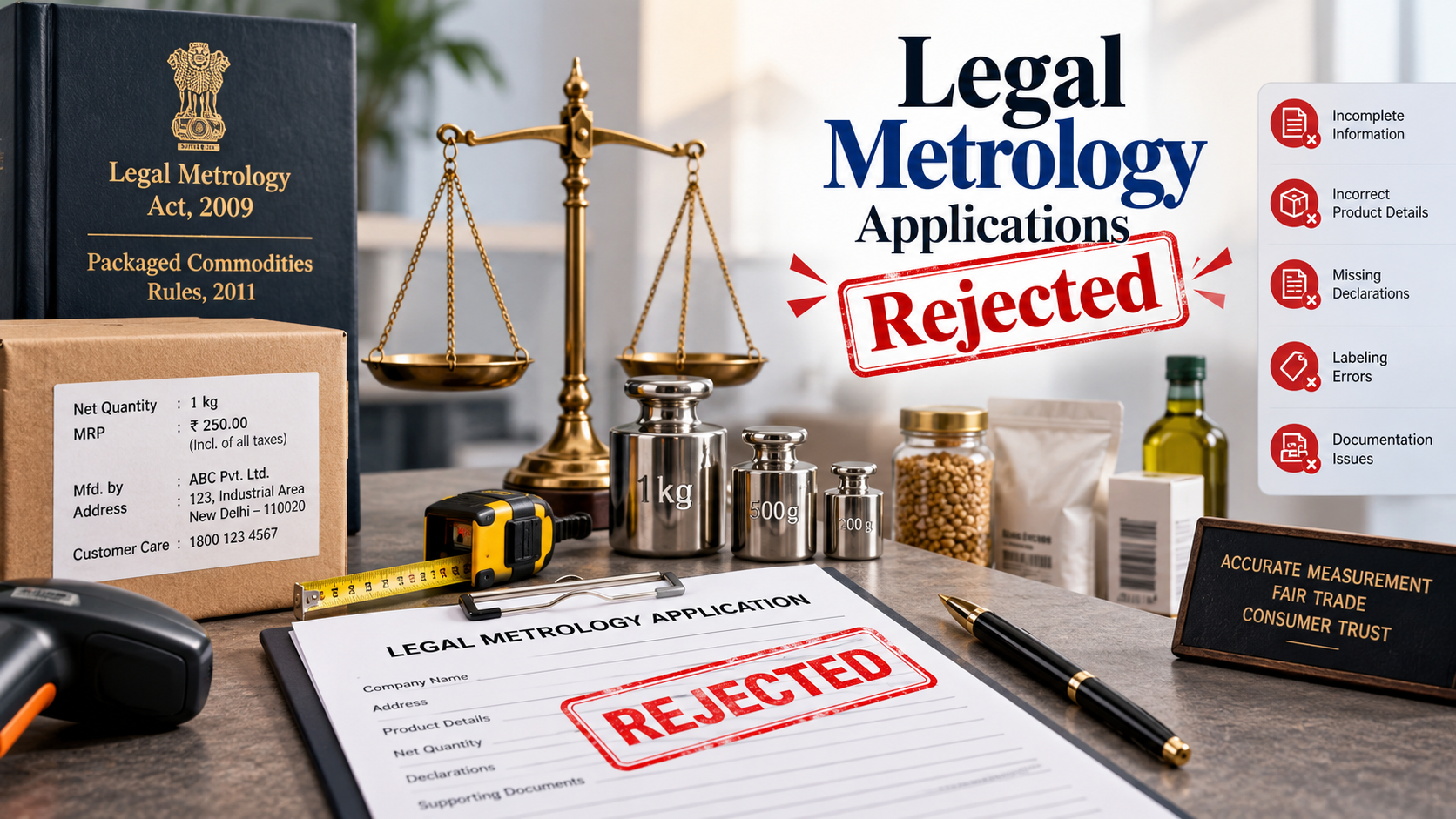
Submitting a Legal Metrology application is not simply about filling out a form and uploading documents. Small inconsistencies in business details, product information, packaging declarations, or supporting documents can create compliance issues and may lead to queries, delays, or rejection.
Understanding the legal metrology application rejection reasons can help businesses review their information carefully before submission. The Legal Metrology Act, 2009 and the Legal Metrology (Packaged Commodities) Rules, 2011 establish requirements concerning weights and measures and declarations on packaged commodities.
For businesses preparing an application, the best approach is to understand the applicable rules, maintain consistent records, and verify every declaration before submitting the application.
What Is Legal Metrology Compliance?
Legal Metrology regulates standards relating to weights and measures and certain aspects of goods sold or distributed by weight, measure, or number. The Legal Metrology Act, 2009 provides the statutory framework, while different rules prescribe requirements for particular activities and products.
For packaged commodities, businesses also need to pay attention to declarations appearing on packages. The Packaged Commodities Rules require declarations to be legible and prominent, while information such as net quantity and retail sale price must meet specified presentation requirements.
Because these requirements involve both applications and product information, errors can occur at several stages.
1. Submitting Incomplete Information
One of the most common legal metrology mistakes is submitting an application without checking whether all required information has been provided.
An application may contain missing business details, incomplete product information, unclear descriptions, or absent supporting information. Even when the main form appears complete, inconsistencies between the application and supporting documents can create problems.
Before submission, businesses should review:
- Legal name of the business
- Registered or relevant business address
- Manufacturer, importer, or packer details, where applicable
- Product information
- Contact details
- Supporting documents
- Applicable declarations
The exact requirements can depend on the type of registration, licence, approval, or activity involved, so businesses should verify the applicable procedure rather than relying on a generic checklist.
2. Incorrect Business or Manufacturer Details
Another important area covered by legal metrology application requirements is accurate identification of the relevant business entity.
For packaged commodities, the rules specifically address declarations concerning the name and address of the manufacturer, packer, or importer.
Problems can arise when the name appearing in the application differs from the name shown on product packaging or supporting records.
For example, differences in:
- Company name
- Address
- Importer details
- Manufacturer details
- Packer information
can create unnecessary clarification requirements.
Businesses should therefore maintain consistent information across applications, invoices, packaging artwork, and supporting documents wherever the applicable rules require consistency.
3. Errors in Product Information
Product descriptions should not be treated as a minor administrative detail.
Incorrect or incomplete product information can make it difficult for authorities to determine whether the application corresponds to the actual commodity being manufactured, packed, imported, or sold.
Before submitting an application, businesses should cross-check product names, variants, quantities, packaging formats, and other relevant specifications against their actual products.
This is particularly important where a business handles multiple products or multiple package sizes.
4. Incorrect or Missing Mandatory Declarations
Legal metrology mandatory declarations are an important part of packaged commodity compliance.
The Legal Metrology (Packaged Commodities) Rules, 2011 prescribe declarations and requirements concerning information displayed on packages. The rules also specify that required declarations should be legible and prominent.
Depending on the applicable provisions, businesses may need to consider information such as:
- Name and address of the manufacturer, packer, or importer
- Common or generic name of the commodity
- Net quantity
- Retail sale price
- Relevant manufacturing or packing information
- Consumer-care information
- Other declarations prescribed for the particular commodity
The exact requirements can vary depending on the product and applicable exemptions or provisions. Therefore, businesses should verify the rules applicable to their specific commodity.
5. Not Checking Packaging Labels Carefully
Packaging is often where compliance errors become visible.
The legal metrology labeling requirements are not limited to simply having information somewhere on a package. The manner in which certain declarations appear can also matter.
For example, the Packaged Commodities Rules state that declarations should be legible and prominent. They also contain specific requirements concerning the presentation of retail sale price and net quantity.
Businesses should therefore review packaging artwork before finalising it.
A useful internal review should check:
- Whether required information is present.
- Whether the information is readable.
- Whether quantities are correctly represented.
- Whether the relevant price declaration is correctly presented.
- Whether manufacturer, packer, or importer information is accurate.
- Whether the outer packaging creates any additional declaration requirement.
6. Ignoring Net Quantity Requirements
Net quantity is another area that requires careful attention.
The Legal Metrology framework includes provisions concerning quantities and permissible errors, while the Packaged Commodities Rules prescribe how net quantity declarations are to be presented.
Businesses should ensure that the quantity stated on the package accurately corresponds with the product and follows the applicable unit and declaration requirements.
A mismatch between product specifications, packaging artwork, and submitted documentation can raise compliance questions.
7. Using Outdated or Incorrect Information
Regulatory requirements can change through amendments, notifications, or applicable state-level procedures.
One mistake businesses make is relying on an old application format, outdated packaging artwork, or information copied from a previous submission without checking whether it remains applicable.
The India Code database records the Legal Metrology (Packaged Commodities) Rules, 2011 and related amendments and notifications.
Therefore, businesses should verify the applicable rules and current requirements before preparing an application.
8. Mismatch Between Application and Packaging
Consistency is one of the simplest ways to reduce avoidable compliance problems.
Consider a situation where the application identifies one manufacturer or importer name while the packaging shows another. Similarly, a product description or quantity in the application may not match the final packaging.
Such discrepancies can result in questions and additional scrutiny.
A pre-submission comparison between the application, supporting documents, and final packaging artwork can help identify these errors early.
9. Overlooking Product-Specific Requirements
Not every commodity has identical compliance considerations.
The legal metrology packaged commodities rules establish requirements for packaged commodities, but businesses should determine which provisions apply to their specific products and circumstances. The Legal Metrology Act also provides rule-making powers covering matters such as package declarations, registration procedures, model approval, and other areas.
This means businesses should avoid assuming that the requirements applicable to one product automatically apply to another.
10. Treating the Application as a One-Time Form-Filling Exercise
The legal metrology application process should be viewed as part of a broader compliance workflow.
A stronger process involves:
Understand → Prepare → Cross-check → Submit → Respond → Maintain
First, identify the applicable legal requirements. Next, prepare accurate business and product information. Then compare the application against supporting documents and packaging. After submission, respond carefully to any authority queries and maintain records for future compliance.
This approach can help reduce avoidable errors.
How to Avoid Legal Metrology Application Rejection
Businesses can reduce the risk of rejection or compliance queries by creating a structured pre-submission review.
Use the following checklist:
- Verify the legal entity name and address.
- Check manufacturer, packer, and importer information where applicable.
- Review all product descriptions.
- Cross-check package sizes and net quantities.
- Review mandatory declarations.
- Check packaging artwork for legibility and prominence.
- Compare application information with supporting documents.
- Confirm that the applicable rules and amendments have been reviewed.
- Check whether product-specific requirements apply.
- Keep copies of submitted documents and declarations.
These steps support better legal metrology compliance requirements management and help identify inconsistencies before they become application problems.
Why Accuracy Matters in Legal Metrology Applications
Legal Metrology compliance is closely connected with consumer information, weights and measures, and fair trade. The regulatory framework is designed to establish standards and regulate relevant transactions involving goods sold or distributed by weight, measure, or number.
For businesses, this means compliance should not be treated as a paperwork exercise. Product labels, quantities, business details, and declarations should all be reviewed as part of one compliance process.
A small error may be easy to correct before submission but considerably more inconvenient after an application has already been submitted.
Final Thoughts
Understanding the legal metrology application rejection reasons can help businesses take a more organised approach to compliance. Incomplete information, incorrect business details, inconsistent product information, missing declarations, packaging errors, and failure to review applicable requirements are all areas that deserve careful attention.
The safest approach is to verify the applicable Legal Metrology provisions, compare every application detail with supporting records, and review the final packaging before submission.
For businesses looking to build a reliable compliance process, OM Garuda Group can help you understand the documentation and regulatory considerations relevant to your business and product category.