
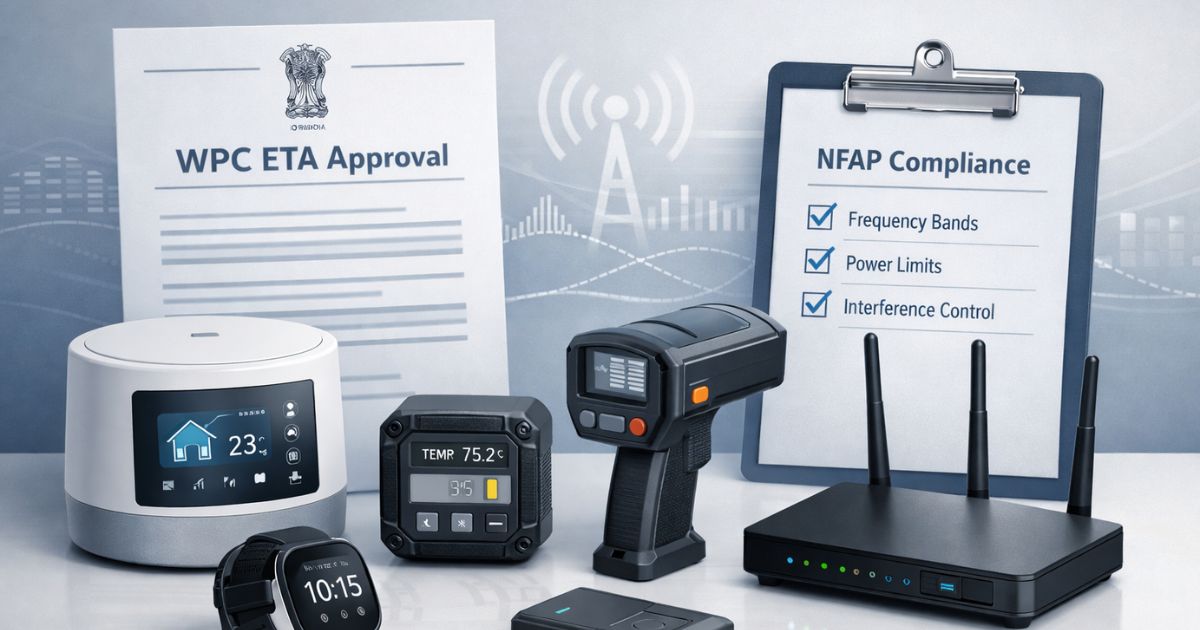
Key Regulatory Considerations for Connected Products
IoT and smart device ecosystem is expanding, spanning smart home appliances, industrial IoT, wearables, connected healthcare devices, asset trackers, and automotive electronics. While innovation is accelerating, regulatory compliance remains a critical gatekeeper for market entry.
Any IoT or smart device that uses wireless communication must comply with India’s radio frequency regulations administered by the Wireless Planning & Coordination (WPC) Wing under the Ministry of Communications. The cornerstone of this compliance is Equipment Type Approval (ETA).
For businesses planning to manufacture, import, or sell connected products in India, understanding ETA/WPC requirements is essential, not only to avoid penalties, but also to ensure uninterrupted customs clearance and lawful market access.
Why ETA/WPC Compliance Matters for IoT Devices
Unlike traditional electronics, IoT devices rely heavily on radio frequency transmission, often continuously, autonomously, and sometimes across multiple bands. This makes them subject to stricter regulatory scrutiny. Non-compliance can lead to customs detention, seizure of goods, monetary penalties, or even prohibition on sale.
ETA/WPC compliance ensures that:
- Devices operate only in permitted de-licensed frequency bands
- RF emissions remain within prescribed power limits
- Wireless operations do not interfere with licensed spectrum users
- Products align with India’s National Frequency Allocation Plan (NFAP)
Understanding ETA in the Context of IoT & Smart Products
ETA (Equipment Type Approval) is a type-level authorization issued for wireless products operating in de-licensed spectrum. It certifies that the radio module or RF functionality of a device complies with Indian frequency and power norms.
ETA does not evaluate:
- Electrical safety
- EMC performance
- Telecom network interoperability
- Cybersecurity or data privacy
Those aspects fall under other regulatory regimes such as BIS, TEC, or sector-specific authorities.
For IoT devices, ETA approval is typically required before import or commercial deployment in India.
Common IoT Technologies Requiring ETA Approval
Most connected devices fall within ETA scope due to their wireless nature. Even low-power or short-range devices are not exempt if they transmit RF signals. Typical technologies include:
- Bluetooth (Classic, BLE)
- Wi-Fi (2.4 GHz / 5 GHz bands, subject to conditions)
- Zigbee
- Z-Wave
- RFID (UHF/HF depending on band)
- LoRa / LoRaWAN (de-licensed configurations)
- Proprietary RF modules operating in ISM bands
Key Regulatory Considerations for IoT & Smart Devices
1. Frequency Band Selection Is Critical
India permits only specific frequency bands for de-licensed use. IoT products designed for global markets often support multiple bands, some of which may not be permitted in India.
Manufacturers must ensure:
- Indian-permitted bands are enabled
- Restricted bands are disabled or firmware-locked
- Declared frequencies exactly match test reports
Incorrect frequency declaration is one of the most common reasons for ETA rejection.
2. RF Power Output and Antenna Configuration
IoT devices often use compact antennas and low-power transmission. However, even small deviations in antenna gain or output power can breach Indian limits.
WPC evaluates:
- Maximum RF output power
- Antenna type (internal/external)
- Antenna gain and orientation
- Effective isotropic radiated power (EIRP)
Any change in antenna design or RF module typically requires a fresh ETA approval.
3. Modular Approval vs End-Product Approval
Many IoT products integrate pre-certified RF modules. While this simplifies testing, ETA approval is still generally required for the final product, not just the module.
Authorities assess:
- How the module is integrated
- Whether RF characteristics remain unchanged
- Whether additional RF components affect emissions
Assuming module certification alone is sufficient often leads to compliance gaps.
4. Multi-Radio and Multi-Band Devices
Smart devices frequently combine multiple wireless technologies, such as Wi-Fi + Bluetooth or RF + cellular fallback. A consolidated technical strategy is necessary to avoid regulatory overlap or misclassification.
In such cases:
- Each RF technology must be clearly documented
- De-licensed bands fall under ETA
- Licensed bands may trigger additional WPC or telecom approvals
5. Imported IoT Products and Customs Scrutiny
Customs authorities increasingly scrutinize IoT and smart devices due to their wireless nature. ETA certificates are often requested during clearance. Obtaining ETA Certificate before dispatch is strongly recommended.
Mismatch between:
- Shipping documents
- Product labels
- ETA details
can result in shipment detention.
ETA Application Process for IoT Devices (Practical Overview)
While the ETA process is documentation-driven, IoT products require careful technical alignment.
For IoT products, special attention must be paid to firmware-controlled RF parameters and declared operating modes.
The ETA Application process typically involves:
- RF testing from an ISO/IEC 17025 accredited lab
- Preparation of technical documents (specifications, block diagrams, manuals)
- Online filing through the WPC ETA portal
- Technical evaluation by WPC officials
- Issuance of ETA certificate for approved model
Post-Approval Compliance for IoT Manufacturers & Importers
ETA approval is not a one-time obligation; it is an ongoing compliance is equally important. Using an ETA certificate beyond its approved scope is treated as non-compliance.
Businesses must ensure:
- No RF-related hardware or firmware changes without re-approval
- Only approved models are imported or sold
- ETA certificates are retained and presented when required
- New variants or upgrades undergo fresh assessment
Common Compliance Pitfalls in IoT Projects
Despite best intentions, many IoT businesses face delays due to:
- Submitting foreign test reports without Indian alignment
- Overlooking antenna gain differences
- Applying under the wrong applicant entity
- Ignoring firmware-controlled frequency behavior
- Treating ETA as optional for low-power devices
How Om Garuda Group Helps You Stay Compliant
IoT compliance sits at the intersection of technology, regulation, and documentation. Om Garuda Group supports businesses across the entire compliance lifecycle for connected products.
Our IoT & ETA/WPC Services Include:
- Regulatory feasibility assessment for IoT designs
- Frequency band and RF architecture analysis
- Coordination with accredited RF testing laboratories
- End-to-end ETA application filing
- Technical query resolution with WPC
- Import and customs compliance advisory
- Post-approval change management guidance
With hands-on experience across consumer, industrial, and enterprise IoT products, we help businesses achieve faster approvals and avoid costly regulatory setbacks.
Closing Thoughts
IoT and smart devices are redefining how technology integrates into everyday life, but in India, wireless innovation must walk hand-in-hand with regulatory compliance. ETA/WPC approval is not merely a procedural formality; it is a legal safeguard that ensures responsible use of radio spectrum.
By addressing compliance early in the product lifecycle and partnering with experienced professionals, businesses can enter the Indian market with confidence, speed, and regulatory certain