
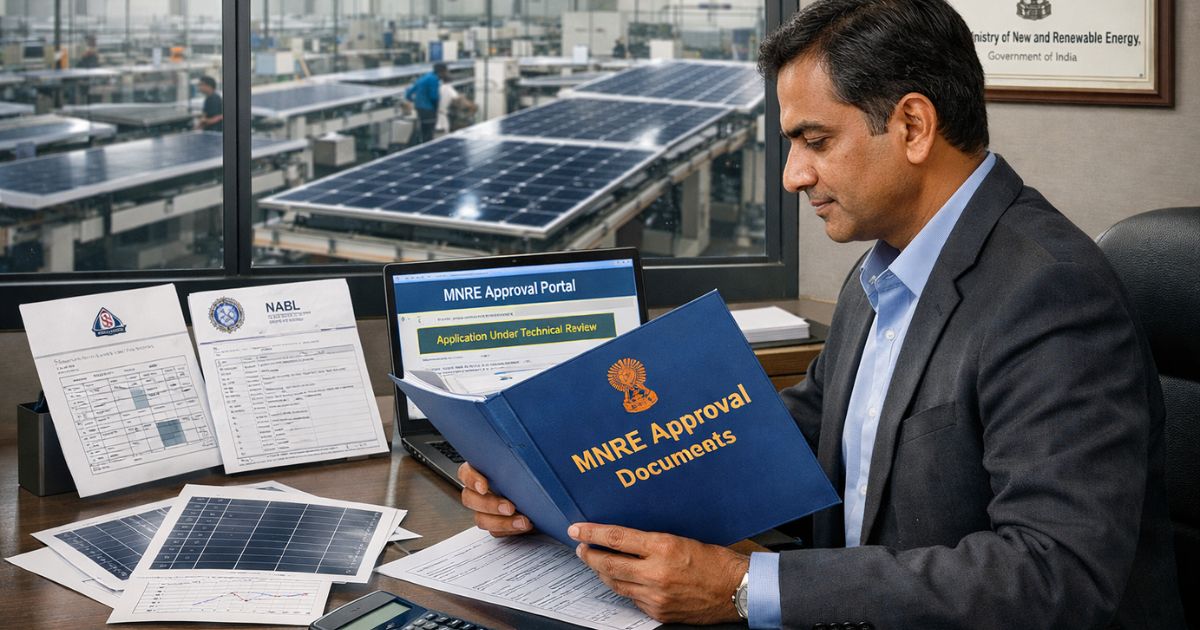
India’s solar sector is expanding rapidly, but growth also means tighter regulatory scrutiny. If you are manufacturing or supplying solar modules, inverters, or other photovoltaic components, regulatory compliance is not optional. MNRE approval for solar products is often a prerequisite for participating in government projects, subsidy-linked schemes, and public procurement.
Many manufacturers assume approval is just a form submission. That’s a mistake. The process involves technical testing, documentation validation, quality compliance, and alignment with evolving government notifications.
This guide breaks down the real MNRE registration process for solar panels, the technical checkpoints involved, and how businesses can move through it efficiently.
Understanding the Regulatory Framework
The entire approval ecosystem is governed by the Ministry of New and Renewable Energy (MNRE). MNRE issues guidelines, quality control orders, and technical specifications for solar products deployed under central and state-supported schemes.
For solar PV modules, compliance is often linked to:
- BIS certification under applicable IS standards
- Testing from NABL-accredited laboratories
- Adherence to Approved List of Models and Manufacturers (ALMM), where applicable
- Performance validation under prescribed IEC standards
When people talk about MNRE certification for solar manufacturers, they usually mean compliance with MNRE guidelines along with BIS and related technical approvals.
Who Actually Needs MNRE Approval?
Not every solar trader requires approval. But the following entities typically do:
- Solar PV module manufacturers
- Cell manufacturers
- Importers supplying to government-backed projects
- EPC contractors bidding in MNRE-supported tenders
- Companies seeking inclusion in approved manufacturer lists
If your target market includes government tenders or subsidy-driven installations, MNRE approved solar panel manufacturer registration becomes mandatory.
The Real MNRE Registration Process for Solar Panels
Let’s be clear. The MNRE registration process for solar panels is not a single-step portal submission. It involves technical evaluation and regulatory validation.
1. Product Testing & Compliance
Modules must be tested as per applicable IEC/IS standards (such as IEC 61215, IEC 61730). Testing must be conducted in NABL-accredited laboratories. Reports must match exact product specifications.
Any deviation in wattage class, cell configuration, or bill of materials can lead to rejection.
2. BIS Certification
Before moving toward MNRE-related approvals, manufacturers must secure BIS certification under relevant Quality Control Orders.
3. Application Submission
Once technical prerequisites are met, the company can apply for MNRE approval online through the designated portal (depending on the applicable scheme or listing requirement).
4. Technical Scrutiny
Authorities review:
- Manufacturing infrastructure
- Production capacity
- Test reports
- Quality management systems
- Previous compliance history
5. Listing / Empanelment
If approved, the manufacturer is listed or empanelled under relevant MNRE frameworks.
Documents Required for MNRE Approval
Incomplete documentation is the number one reason applications get delayed. The typical documents required for MNRE approval include:
- Certificate of Incorporation
- GST Registration
- PAN of company
- BIS certificate
- Detailed product technical datasheets
- NABL lab test reports
- Manufacturing plant layout
- Production capacity declaration
- Quality control process documentation
- Undertaking and compliance declarations
Even small mismatches in technical data sheets and lab reports can result in objections.
MNRE Empanelment Process - What It Really Means
The MNRE empanelment process is often misunderstood. Empanelment generally applies when the government wants to shortlist approved manufacturers for specific schemes or procurement programs.
Empanelment usually requires:
- Proven manufacturing capability
- Compliance with minimum domestic value addition (if applicable)
- Past performance credentials
- Financial stability documentation
Empanelment status is time-bound and may require renewal or periodic compliance reporting.
How to Get MNRE Approval in India Without Delays
If you're asking how to get MNRE approval in India, here’s the blunt answer: preparation determines speed.
Common mistakes include:
- Submitting outdated test reports
- Mismatch between model numbers in BIS and MNRE application
- Incomplete manufacturing capacity declaration
- Ignoring scheme-specific technical notifications
The correct approach involves:
- Conducting a compliance gap analysis
- Validating technical documentation internally
- Cross-checking product specifications
- Ensuring alignment between BIS, lab reports, and MNRE submission
Skipping these checks leads to queries and delays.
Cost of MNRE Approval for Solar Products
The cost of MNRE approval for solar products varies based on product category and compliance status. Broadly, cost components include:
- Laboratory testing charges
- BIS certification fees
- Government processing fees (where applicable)
- Documentation preparation costs
- Consultant professional charges (if hired)
Testing alone can be a significant expense, especially if re-testing is required due to non-conformity.
Manufacturers should treat this as a compliance investment, not an administrative cost.
Should You Hire an MNRE Approval Consultant in India?
Many companies attempt the process internally. That works only if you have a dedicated compliance team familiar with renewable energy regulations.
An experienced MNRE approval consultant in India helps in:
- Pre-application technical audit
- Documentation alignment
- Managing portal submissions
- Responding to authority queries
- Reducing risk of rejection
This becomes particularly important when dealing with multi-model product portfolios.
How Om Garuda Group Helps
Navigating regulatory frameworks requires both technical understanding and procedural clarity. Om Garuda Group assists solar manufacturers with structured compliance support.
Here’s how:
- Detailed review of manufacturing and product specifications
- Coordination with testing laboratories
- Assistance in BIS documentation alignment
- End-to-end handling of MNRE-related submissions
- Guidance on the MNRE empanelment process
- Clarification on cost structure and documentation gaps
Instead of reacting to government objections, the focus is on preventing them through technical accuracy and structured compliance management.
For companies looking for MNRE approved solar panel manufacturer registration, early-stage advisory significantly reduces rejection risk.
Common Reasons Applications Get Rejected
Let’s address reality. Rejections happen due to:
- Discrepancy in module ratings
- Incomplete or expired lab reports
- Non-compliance with updated MNRE notifications
- Incorrect model categorization
- Insufficient manufacturing infrastructure proof
Compliance is not static. Regulations evolve, and manufacturers must track circulars and amendments regularly.
Final Thoughts
The solar sector in India is competitive and regulation-driven. Compliance is now part of business strategy, not just a licensing requirement.
Understanding the technical depth behind MNRE approval for solar products is critical for manufacturers aiming to participate in high-value government and institutional projects.
If handled systematically, the approval process is manageable. If handled casually, it becomes expensive and time-consuming.
The difference lies in preparation, documentation accuracy, and regulatory awareness.