
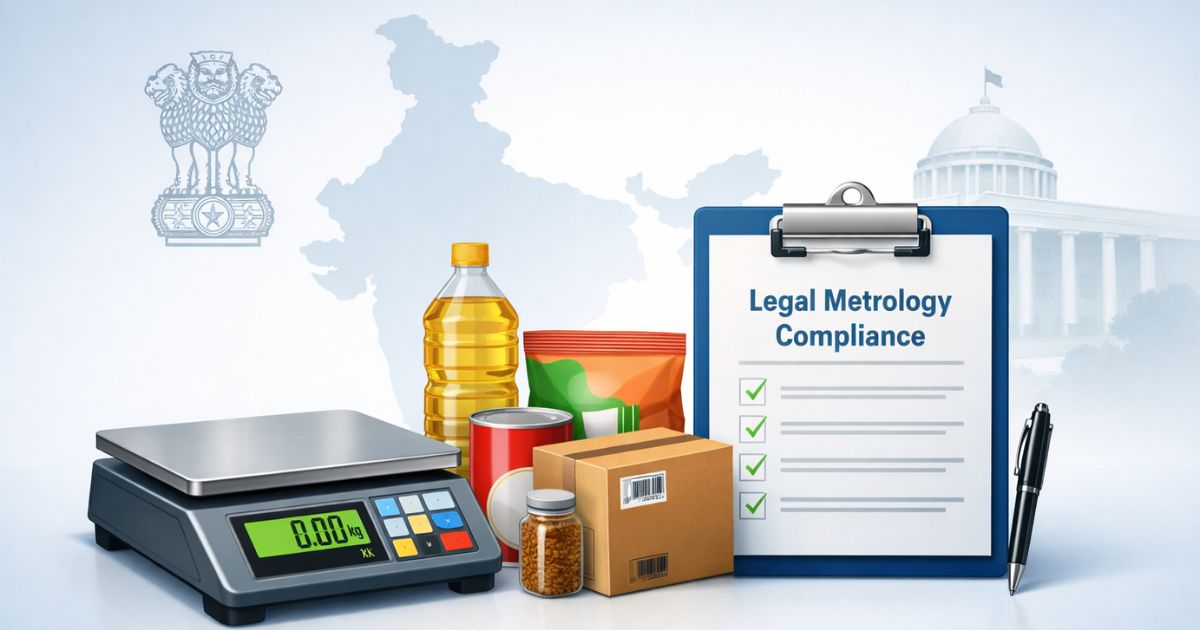
In India, accuracy in trade is not just good practice; it is a legal obligation. Whether a business deals in packaged goods, weighing instruments, or measuring devices, compliance with Legal Metrology laws is mandatory. Legal Metrology Certificate plays a critical role in ensuring transparency, fairness, and consumer protection across markets.
This blog explains the Legal Metrology Act, 2009, its scope, and the Legal Metrology registration requirements in a technically accurate yet easy-to-understand manner.
What Is Legal Metrology?
Legal Metrology refers to the application of statutory requirements to weights, measures, measuring instruments, and pre-packaged commodities. The objective is to ensure that consumers receive the correct quantity of goods and that trade transactions are based on standardized and verified measurements.
In India, Legal Metrology Registration is governed by the Legal Metrology Act, 2009, along with associated rules such as the Legal Metrology (Packaged Commodities) Rules, 2011.
Overview of the Legal Metrology Act, 2009
The Legal Metrology Act, 2009 came into force to replace earlier laws related to weights and measures and to align Indian practices with international standards. The Legal Metrology Act empowers both Central and State Governments to administer, enforce, and regulate compliance.
Key Objectives of the Legal Metrology Certificate Act:
- Standardization of weights and measures
- Regulation of trade and commerce in measured goods
- Protection of consumer interests
- Prevention of unfair trade practices
- Ensuring uniform enforcement across India
Scope of Legal Metrology in India
The scope of Legal Metrology Registration is broad and applies to multiple categories of businesses.
Covered Under the Act:
- Manufacturers of weights, measures, and measuring instruments
- Importers of pre-packaged commodities and measuring devices
- Packers and Re-packers
- Dealers and Repairers of weighing and measuring instruments
- Retailers and Distributors selling pre-packaged goods
Any product that is sold, distributed, or imported based on weight, measure, or number falls within the scope of Legal Metrology License..
What Is Legal Metrology Registration?
Legal Metrology Registration is a statutory approval required before engaging in activities involving regulated goods. Depending on the nature of business, registration or licensing may be required at the Central level, State level, or both. For importers of pre-packaged goods, LMPC Registration under the Packaged Commodities Rules is mandatory prior to customs clearance.
Common Types of Legal Metrology Registrations:
- Importer Registration
- Manufacturer License
- Packer Registration
- Dealer License
- Repairer License
LMPC Registration: A Critical Requirement
LMPC stands for Legal Metrology Packaged Commodities. LMPC registration is compulsory for entities dealing in pre-packaged commodities intended for sale in India.
When Is LMPC Registration Required?
- Import of packaged goods
- Manufacturing or packing of goods for retail sale
- Repacking or relabeling activities
Key Declarations Required on Packages:
- Name and address of manufacturer/importer/packer
- Net quantity (weight, measure, or number)
- Month and year of manufacture/import/packing
- Maximum Retail Price (MRP) inclusive of all taxes
- Customer care contact details
- Country of origin (for imported goods)
Failure to comply with labeling norms can lead to penalties, product seizure, or suspension of registration.
Role of Model Approval in Legal Metrology
Model Approval is another critical component of Legal Metrology compliance. It applies to weights and measuring instruments such as weighing scales, flow meters, fuel dispensers, and similar devices.
Model approval must be obtained before manufacturing or importing regulated measuring instruments in India. Once approved, state-level licenses can be applied for manufacture, sale, or use.
Why Model Approval Is Required:
- To verify the accuracy and reliability of measuring instruments
- To ensure conformity with Indian metrology standards
- To prevent manipulation or incorrect measurement in trade
Authorities Governing Legal Metrology Certificate
- Department of Consumer Affairs (Central Government)
Handles importer registration, model approval, and central-level enforcement. - State Legal Metrology Departments
Responsible for issuing manufacturing, dealer, and repairer licenses, inspections, and enforcement.
Note: This dual structure ensures nationwide uniformity with localized implementation.
Penalties for Non-Compliance with Legal Metrology Registration
Non-compliance with Legal Metrology Registration provisions can attract:
- Monetary penalties
- Compounding fees
- Seizure of goods
- Cancellation or suspension of licenses
- Legal prosecution in severe cases
Conclusion
Legal Metrology Registration is not merely a regulatory formality; it is a foundational requirement for ethical, transparent, and lawful trade in India. The Legal Metrology Act, 2009, ensures that businesses operate on standardised measurement practices while safeguarding consumer rights.
For manufacturers, importers, and brand owners, understanding the scope and requirements of Legal Metrology compliance is crucial to avoid penalties and ensure smooth market entry. With increasing regulatory scrutiny and digitisation of processes, timely and accurate registration has become more important than ever.
How Om Garuda Group Helps You Stay Compliant
Navigating Legal Metrology compliance can be complex, time-consuming, and highly technical. This is where Om Garuda Group becomes your trusted compliance partner.
We provide end-to-end Legal Metrology solutions like checking:
- Eligibility assessment and compliance mapping
- LMPC registration for importers, manufacturers, and packers
- Model approval for weighing and measuring instruments
- Labeling verification and packaging compliance audits
- Documentation preparation and online application filing
- Coordination with Legal Metrology authorities
- Post-registration support, renewals, and compliance updates