
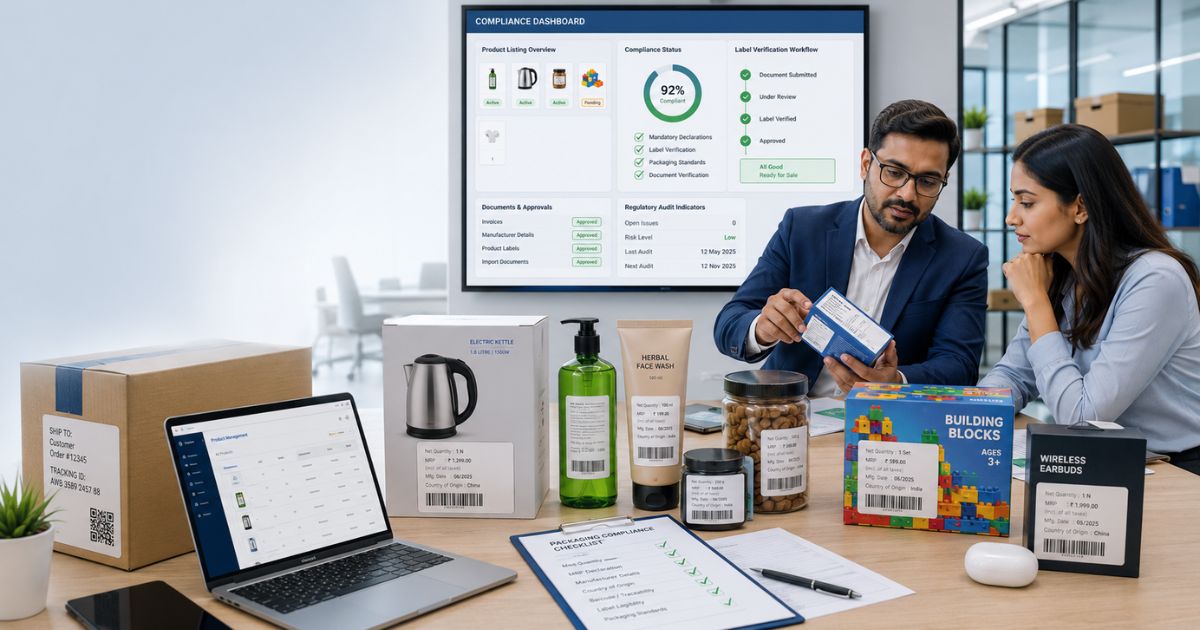
Online shopping has transformed how businesses sell products in India. Whether you're selling through Amazon, Flipkart, Meesho, Myntra, Jiomart, or your own Shopify store, complying with India's legal requirements is just as important as offering quality products. One of the most overlooked yet essential regulations is Legal Metrology Compliance for E-commerce Sellers.
Many online sellers focus on product listings, pricing, and marketing but fail to ensure that their packaged products meet mandatory labeling and declaration requirements. Non-compliance can result in penalties, product delisting, customer complaints, or regulatory action.
This guide explains Legal Metrology for E-commerce Sellers, who needs to comply, the applicable rules, mandatory declarations, and how businesses can stay compliant while building customer trust.
What is Legal Metrology Compliance?
Legal Metrology refers to the laws governing weights, measures, and packaged commodities sold in India. It ensures that consumers receive accurate information about the products they purchase and protects them from misleading packaging or incorrect quantity declarations.
The framework is primarily governed by the Legal Metrology Act, 2009 and the Legal Metrology (Packaged Commodities) Rules, 2011. These regulations prescribe mandatory declarations that must appear on packaged goods before they are offered for sale, including on e-commerce platforms.
For online businesses, Legal Metrology Compliance in India means ensuring that products sold through digital marketplaces meet all applicable labeling requirements and that mandatory information is accurately displayed to consumers.
Why Legal Metrology Compliance is Important for E-commerce Sellers
E-commerce customers cannot physically inspect products before making a purchase. They rely entirely on the product information provided online and on the package they receive.
Complying with legal metrology requirements helps businesses:
- Build customer confidence through transparent product information.
- Reduce disputes related to quantity, pricing, and labeling.
- Avoid penalties and regulatory enforcement.
- Maintain uninterrupted selling privileges on online marketplaces.
- Strengthen brand credibility and consumer trust.
Today, major marketplaces such as Amazon and Flipkart expect sellers to comply with applicable laws. As a result, Legal Metrology Compliance for E-commerce Sellers has become an essential part of operating a successful online business rather than just a legal formality.
Legal Framework Governing E-commerce Sellers
Several legal provisions regulate the sale of packaged commodities through online platforms.
The most relevant laws include:
- Legal Metrology Act, 2009
- Legal Metrology (Packaged Commodities) Rules, 2011
- Consumer Protection (E-commerce) Rules, 2020
Together, these regulations require businesses to provide clear, accurate, and transparent product information before and after a purchase.
The E-commerce Legal Metrology Rules ensure that consumers receive the same essential information online that they would find on the physical product package in a retail store.
This creates a fair marketplace where buyers can compare products and make informed purchasing decisions.
Which Online Sellers Need to Comply?
A common misconception is that only manufacturers are responsible for legal metrology compliance. In reality, responsibility extends across the entire supply chain.
Businesses that should understand Legal Metrology Registration for Online Sellers and related compliance requirements include:
- Manufacturers selling directly online
- Brand owners
- Importers of packaged goods
- Retailers selling through e-commerce marketplaces
- Amazon sellers
- Flipkart sellers
- Meesho sellers
- Shopify store owners
- D2C (Direct-to-Consumer) brands
- Businesses selling packaged consumer goods
If your products are sold in pre-packaged form and fall under the applicable rules, legal metrology obligations may apply regardless of the sales channel.
Mandatory Declarations on Packaged Products
One of the most important aspects of Legal Metrology Compliance in India is ensuring that every applicable packaged commodity carries the required declarations.
Depending on the nature of the product and applicable regulations, packages generally need to display information such as:
- Name and address of the manufacturer, packer, or importer
- Product name
- Net quantity
- Maximum Retail Price (MRP)
- Month and year of manufacture, packing, or import, where applicable
- Customer care details
- Country of origin for imported products, where required
These declarations help consumers verify product authenticity and make informed purchasing decisions.
In addition to the physical package, many online marketplaces also require sellers to display similar information on the product listing page to comply with applicable E-commerce Legal Metrology Rules and consumer protection requirements.
Understanding LMPC Registration for E-commerce Sellers
Many businesses confuse general legal metrology compliance with LMPC Registration for E-commerce Sellers. While they are related, they are not the same.
LMPC (Legal Metrology Packaged Commodities) registration is particularly relevant for businesses involved in importing pre-packaged commodities into India. Importers must comply with specific legal metrology requirements before selling such products in the Indian market.
For example, businesses importing packaged cosmetics, electronics, kitchen appliances, toys, food containers, or household products should determine whether LMPC Registration for E-commerce Sellers is applicable to their operations before listing products online.
Understanding these obligations early helps businesses avoid delays, customs issues, or compliance notices.
Common Compliance Mistakes Made by Online Sellers
Many sellers unintentionally violate legal metrology requirements due to limited awareness or outdated labeling practices.
Some of the most common mistakes include:
- Missing mandatory declarations on product packaging.
- Incorrect or outdated manufacturer details.
- Displaying inaccurate net quantity.
- Printing unclear or illegible labels.
- Incorrect MRP declaration.
- Selling imported packaged goods without meeting applicable legal requirements.
- Providing incomplete product information on marketplace listings.
- Assuming compliance is solely the manufacturer's responsibility.
These errors can lead to customer complaints, marketplace warnings, or action by regulatory authorities. Conducting regular compliance reviews helps businesses identify and correct issues before they become costly.
Steps to Ensure Legal Metrology Compliance
Achieving compliance does not have to be complicated if businesses follow a systematic approach. Whether you are launching a new product or expanding your online store, these steps can help you meet the applicable legal requirements.
1. Identify Whether Your Products Are Covered
Start by determining whether the products you sell fall under the scope of the Legal Metrology Packaged Commodities Rules for E-commerce. Most pre-packaged consumer goods sold through online marketplaces are subject to these rules.
2. Verify Product Labels
Review every product package to ensure it carries all mandatory declarations required under the applicable regulations. The information should be accurate, complete, and clearly visible to consumers.
3. Determine Registration Requirements
Businesses importing pre-packaged goods should assess whether an LMPC Registration for E-commerce Sellers is required before marketing or selling their products in India. Understanding this requirement at an early stage can help prevent customs-related issues and regulatory delays.
4. Update Marketplace Listings
The information displayed on Amazon, Flipkart, Meesho, and other online platforms should match the declarations provided on the product packaging. Consistency between physical labels and online listings helps maintain transparency and reduces the likelihood of customer disputes.
5. Conduct Regular Compliance Audits
Businesses often update packaging, pricing, suppliers, or product specifications over time. Periodic compliance audits help ensure that product labels continue to meet the latest legal requirements and reduce the risk of violations.
Penalties for Non-Compliance
Ignoring Legal Metrology Compliance for E-commerce Sellers can have serious consequences. Regulatory authorities may take action if products fail to meet mandatory declaration requirements or violate applicable provisions of the Legal Metrology Act and related rules.
Depending on the nature and severity of the violation, businesses may face:
- Monetary penalties under applicable legal provisions.
- Product seizure or inspection by authorities.
- Notices requiring corrective action.
- Temporary suspension or removal of product listings by e-commerce platforms.
- Damage to brand reputation and customer trust.
Apart from legal consequences, non-compliance can also affect business operations by delaying product launches and increasing operational costs associated with corrective measures.
Best Practices for Online Sellers
Maintaining compliance is an ongoing responsibility rather than a one-time task. Adopting good compliance practices can help businesses avoid regulatory issues and improve customer confidence.
Some recommended practices include:
- Review packaging artwork before printing.
- Maintain updated records of manufacturers, importers, and suppliers.
- Verify MRP and quantity declarations before listing products.
- Ensure imported products meet applicable Indian labeling requirements.
- Periodically review marketplace listings for accuracy.
- Train internal teams on legal labeling requirements.
- Seek professional guidance whenever regulations are updated.
By following these practices, businesses can strengthen their Online Seller Legal Compliance in India while ensuring a better buying experience for customers.
How Om Garuda Group Can Help
Understanding legal requirements is one thing; implementing them correctly is another. Businesses often face challenges in interpreting regulations, identifying applicable requirements, and preparing compliant documentation.
Om Garuda Group provides professional regulatory compliance support for manufacturers, importers, brand owners, and e-commerce businesses across India.
Our services include:
- Legal Metrology compliance assessment
- Guidance on Legal Metrology Registration for Online Sellers
- Assistance with LMPC Registration for E-commerce Sellers
- Product label compliance review
- Documentation support
- Regulatory consultation
- End-to-end compliance assistance for imported packaged commodities
Our experienced team works closely with businesses to simplify the compliance process and help them meet regulatory requirements efficiently.
Conclusion
As India's e-commerce industry continues to grow, regulatory compliance has become a critical aspect of running a successful online business. Whether you sell through Amazon, Flipkart, Meesho, Shopify, or your own website, ensuring compliance with the E-commerce Legal Metrology Rules helps protect your business and builds consumer trust.
Understanding the requirements of Legal Metrology Compliance in India, maintaining accurate product declarations, and determining whether an LMPC Certificate for Amazon Sellers or other import-related compliance obligations apply can significantly reduce legal risks.
Rather than viewing compliance as an administrative burden, businesses should treat it as an investment in transparency, customer satisfaction, and long-term growth.
If you need expert assistance with Legal Metrology Compliance for E-commerce Sellers, Om Garuda Group offers reliable guidance to help your business meet regulatory requirements with confidence.