
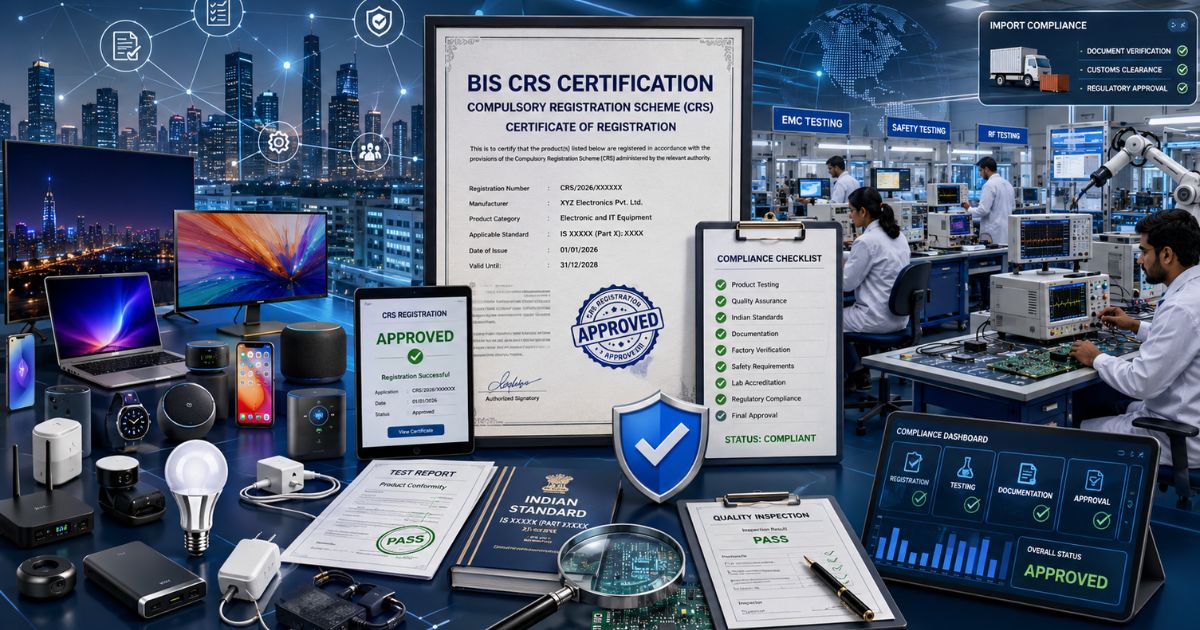
India's electronics and IT sector continues to witness rapid growth, driven by increasing consumer demand, digital transformation, IoT adoption, and smart technology innovations. To ensure product safety, quality, and compliance, the Government of India has significantly expanded the scope of the Compulsory Registration Scheme (CRS) administered by the Bureau of Indian Standards (BIS).
For manufacturers, importers, brand owners, and foreign companies looking to enter the Indian market, understanding the latest BIS CRS requirements has become more important than ever.
In this article, we explore the latest product categories covered under BIS CRS Certification in 2026, the compliance requirements, application process, and how businesses can successfully obtain BIS Registration for their products.
What is BIS CRS Certification?
The Compulsory Registration Scheme (CRS) was introduced by the Ministry of Electronics and Information Technology (MeitY) and is administered by the Bureau of Indian Standards (BIS).
Under this scheme, manufacturers of notified electronic and IT products must obtain BIS registration before selling, importing, distributing, or marketing their products in India.
The primary objective of CRS is to:
- Ensure consumer safety
- Improve product quality
- Prevent the sale of substandard electronic goods
- Strengthen regulatory oversight of electronics and IT equipment
Products covered under CRS must be tested in BIS-recognized laboratories and registered with BIS before being introduced into the Indian market.
Why BIS CRS Certification is Important in 2026
India continues to expand the scope of regulated electronics products under CRS.
With the growing adoption of:
- Smart devices
- Consumer electronics
- Wireless technologies
- IoT products
- Home automation systems
- Power equipment
regulators are increasingly focusing on ensuring product safety and conformity with applicable Indian Standards.
Without BIS CRS Certification, covered products cannot be legally:
- Imported into India
- Sold in the Indian market
- Distributed through online marketplaces
- Supplied to government procurement channels
Non-compliance can result in customs detention, penalties, product recalls, and enforcement actions.
Latest Product Categories Covered Under BIS CRS in 2026
The CRS framework now covers more than 75 categories of electronic and IT products, making it one of India's most significant product compliance schemes.
Below are some major product categories currently covered under BIS CRS.
Consumer Electronics
Consumer electronics remain one of the largest segments under CRS.
Products include:
- Smart Televisions
- LED Televisions
- Digital Cameras
- Set Top Boxes
- Smart Speakers
- Audio Equipment
- Multimedia Devices
With the increasing demand for connected consumer products, manufacturers must carefully assess BIS applicability before market entry.
Information Technology Equipment
IT hardware products continue to be extensively regulated under CRS.
Covered products include:
- Laptops
- Tablets
- Personal Computers
- Servers
- Monitors
- Printers
- Scanners
- Plotters
Foreign manufacturers exporting IT equipment to India must obtain BIS registration through the Foreign Manufacturers Certification process applicable under CRS.
Mobile Phones and Communication Devices
The smartphone ecosystem remains one of the most regulated categories under BIS.
Products include:
- Mobile Phones
- Smartphones
- Fixed Wireless Phones
- IP Phones
- Communication Devices
Given the volume of imports in this category, BIS compliance remains a critical requirement for customs clearance and market access.
Smart Home and IoT Products
As India's smart home market expands, many connected products are now subject to BIS compliance requirements.
Examples include:
- Smart Plugs
- Smart Switches
- Smart Controllers
- Home Automation Hubs
- Connected Appliances
- Smart Displays
Depending on the product architecture, additional approvals such as ETA Certification may also be required.
Power Adaptors and Chargers
Power supply products remain among the most actively regulated categories under CRS.
Covered products include:
- USB Chargers
- Mobile Chargers
- Laptop Adaptors
- Power Banks
- External Power Supplies
Importers frequently face customs clearance challenges when BIS certification is not obtained prior to shipment.
Lighting Products
Lighting products continue to remain under the CRS framework.
Examples include:
- LED Lamps
- LED Modules
- LED Drivers
- Smart Lighting Systems
Manufacturers must ensure testing is conducted against the applicable Indian Standard before registration.
Audio and Video Equipment
The growth of digital entertainment and smart media devices has increased compliance requirements for audio-video products.
Examples include:
- Wireless Speakers
- Sound Bars
- Amplifiers
- Digital Media Players
- Audio Streaming Devices
Many of these products may simultaneously require BIS and ETA approval.
Smart Wearables and Accessories
The wearable technology segment continues to expand rapidly.
Examples include:
- Smart Watches
- Fitness Trackers
- Connected Health Devices
- Smart Bands
Manufacturers should verify whether their products fall under notified CRS categories or require additional approvals.
UPS, Inverters and Power Equipment
Energy and power management products remain heavily regulated.
Covered products include:
- UPS Systems
- Inverters
- Power Converters
- Battery Chargers
Testing requirements vary depending on product design and applicable standards.
Recent BIS CRS Expansion Trends
While BIS periodically updates the CRS framework through notifications issued by MeitY, recent regulatory trends indicate increasing focus on:
Smart Consumer Electronics
Rapid adoption of AI-enabled and connected devices continues to drive new compliance requirements.
IoT and Connected Devices
Products integrating wireless connectivity, cloud functions, and smart control features are receiving greater regulatory attention.
Energy Efficiency and Safety
Power equipment, chargers, and energy-related products continue to be prioritized due to safety concerns.
Digital Infrastructure Products
The growing digital economy has increased scrutiny of IT and networking equipment.
Businesses should continuously monitor regulatory notifications to identify newly added product categories.
BIS CRS Registration Process in India
Obtaining BIS CRS Certification involves multiple compliance stages.
Step 1: Product Classification
Identify the applicable Indian Standard and determine whether the product falls under a notified CRS category.
Step 2: Product Testing
Testing must be conducted through a BIS-recognized laboratory.
The laboratory evaluates compliance with the relevant Indian Standard.
Step 3: Documentation Preparation
Documentation typically includes:
- Test Reports
- Product Specifications
- Manufacturing Details
- Factory Information
- Trademark Documents
- Authorization Letters
Step 4: BIS Application Filing
The application is submitted through the BIS online portal along with all supporting documents.
Step 5: Grant of Registration
Upon successful evaluation, BIS grants CRS registration and authorizes the use of the Standard Mark with Registration Number.
Common Challenges Faced by Manufacturers and Importers
Many businesses encounter delays due to:
Incorrect Product Classification
Choosing the wrong Indian Standard often leads to application rejection.
Incomplete Documentation
Missing information remains one of the most common reasons for processing delays.
Testing Non-Conformities
Products that fail laboratory testing require corrective actions and re-testing.
Multi-Regulatory Requirements
Many products require:
Failure to identify all applicable regulations can significantly delay market entry.
Why Businesses Should Obtain BIS CRS Certification Early
Early compliance helps organizations:
✔ Avoid customs clearance delays
✔ Prevent shipment detention
✔ Reduce regulatory risks
✔ Improve brand credibility
✔ Enable faster product launches
✔ Meet marketplace and distributor requirements
✔ Expand business opportunities in India
For foreign manufacturers, obtaining BIS certification before shipment planning can save significant time and operational costs.
How Om Garuda Group Helps with BIS CRS Certification
BIS compliance can be complex, especially for foreign manufacturers, importers, and businesses launching new electronic products in India.
At Om Garuda Group, we provide end-to-end BIS Registration services designed to simplify the certification process and accelerate approvals.
Our services include:
- BIS Applicability Assessment
- Product Classification Support
- BIS CRS Registration
- Foreign Manufacturer Compliance Assistance
- Documentation Preparation
- BIS Testing Coordination
- Regulatory Liaison
- BIS Renewal and Amendment Support
- BIS + ETA + LMPC + EPR Compliance Mapping
With more than 6 years of regulatory consulting experience and over 1000 successful compliance projects, we help businesses navigate India's evolving regulatory landscape with confidence.
Looking for BIS CRS Certification for Your Products?
Whether you are importing consumer electronics, IT equipment, smart home devices, power supplies, or connected technologies, Om Garuda Group can help you obtain BIS Registration efficiently and compliantly.
Contact Om Garuda Group today for expert BIS CRS Certification, ETA Approval, LMPC Registration, and EPR Compliance services.