
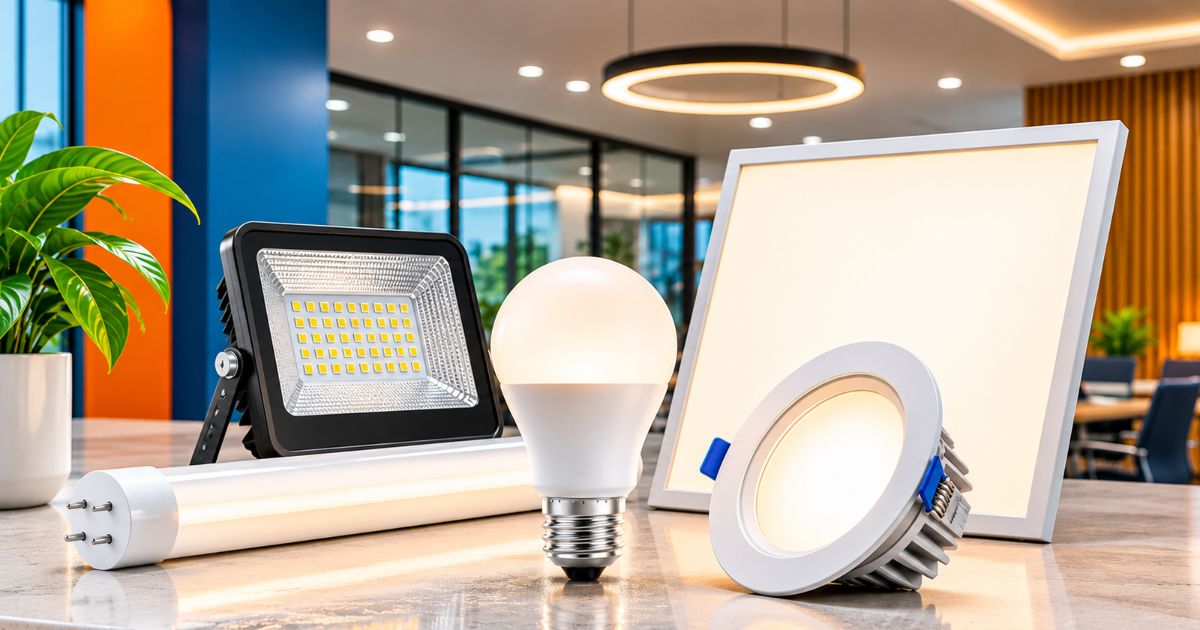
LED lamps and lighting products are widely used in homes, offices, commercial buildings, factories, and public infrastructure. As the Indian market grows, product safety, electrical performance, and quality have become important considerations for manufacturers, importers, and brand owners. Businesses selling notified LED products in India must check whether their products fall under the Bureau of Indian Standards (BIS) Compulsory Registration Scheme (CRS).
BIS registration for LED lights is not a single certification that covers every type of LED product. Different products, such as self-ballasted LED lamps, LED modules, and LED luminaires, may fall under different Indian Standards. Selecting the correct standard is the first step because the testing and registration requirements depend on the product category.
This guide explains the applicable BIS standards, registration process, testing requirements, and recent updates that LED manufacturers and importers should understand before entering the Indian market.
Is BIS Registration Mandatory for LED Lamps in India?
Yes, BIS registration is mandatory for LED products covered under the applicable Compulsory Registration Order (CRO). Manufacturers cannot manufacture, import, distribute, or sell notified products in India without meeting the relevant conformity requirements and obtaining the required BIS registration.
LED bulbs, LED modules, and several categories of LED luminaires are covered under the CRS framework. The applicable standard depends on the product's design and intended use. For example, a self-ballasted LED bulb and a fixed LED ceiling luminaire are not assessed under the same product standard.
The BIS CRS framework requires manufacturers to get their products tested in a BIS-recognised laboratory and apply for registration through the prescribed process. The registration is associated with the manufacturer, product, and brand details covered by the approval.
Bureau of Indian Standards+2
Which BIS Standards Apply to LED Lighting Products?
Understanding the relevant standards is one of the most important BIS requirements for LED lighting products. The following table covers commonly relevant categories and standards.
|
LED product category |
Relevant Indian Standard |
|
Self-ballasted LED lamps |
IS 16102 (Part 1) and IS 16102 (Part 2) |
|
LED modules for general lighting |
IS 16103 (Part 1) and IS 16103 (Part 2) |
|
Fixed general-purpose LED luminaires |
IS 10322 (Part 5/Sec 1) |
|
Recessed LED luminaires |
IS 10322 (Part 5/Sec 2) |
|
LED road and street lighting |
IS 10322 (Part 5/Sec 3) |
|
LED floodlights |
IS 10322 (Part 5/Sec 5) |
|
LED handlamps |
IS 10322 (Part 5/Sec 6) |
|
LED lighting chains |
IS 10322 (Part 5/Sec 7) |
|
LED emergency lighting luminaires |
IS 10322 (Part 5/Sec 8) |
These standards address different product characteristics. Manufacturers should verify the latest standard edition and the product category listed under the CRS before arranging laboratory testing.
CRSBIS+2
IS 16102 Part 1 for LED Lamps: Safety Requirements
IS 16102 (Part 1) covers safety requirements for self-ballasted LED lamps used for general lighting. A self-ballasted lamp has an integrated control or driver arrangement, allowing it to operate through a compatible lamp holder without a separate external driver.
The standard addresses safety risks that can arise during normal use and under specified test conditions. These include:
- Protection against electric shock
- Insulation resistance and electrical strength
- Resistance to heat and fire
- Mechanical strength
- Cap interchangeability and construction
- Marking and product identification
The revised IS 16102 (Part 1):2026 supersedes the 2012 edition. BIS initially set 2 August 2026 as the last date for concurrent implementation, but subsequently extended the implementation deadline to 2 February 2027. Manufacturers with existing registrations should review the revised requirements and complete the required testing and migration steps within the extended period.
BIS+2
IS 16102 Part 2 LED Lamp Performance Requirements
Safety is only one part of LED lamp compliance. Performance also matters because consumers expect products to deliver the lighting output and operating characteristics stated on their packaging.
IS 16102 Part 2 LED lamp performance requirements address the performance of self-ballasted LED lamps. Relevant performance parameters include luminous flux, efficacy, colour characteristics and endurance, as specified by the applicable edition of the standard.
The 2026 revision of Part 2 is also important. Manufacturers should not automatically rely on older test reports or assume that previous product specifications remain sufficient. They should confirm the current edition, applicable CRS requirements, and testing arrangements with a BIS-recognised laboratory before applying.
BIS+2
BIS Certification for LED Luminaires and Other Lighting Products
LED luminaires are complete lighting units designed to distribute light from one or more light sources. They may include LED modules, drivers, heat sinks, reflectors, lenses, and housing components.
BIS certification for LED luminaires depends on the type and intended application of the product. Fixed ceiling lights, recessed lights, streetlights, floodlights, and emergency lighting products have different applicable standards.
BIS published revised editions of several IS 10322 Part 5 standards in 2026. The concurrent implementation period for the listed revised LED luminaire standards was extended to 2 February 2027. This means manufacturers should check the applicable old and revised editions and follow the latest BIS migration instructions rather than relying only on previous approvals.
CRSBIS+2
BIS CRS Registration for LED Lights: Step-by-Step Process
The registration process requires product testing and submission of manufacturer information. A typical application involves the following stages:
- Identify the product category: Determine whether the product is a self-ballasted LED lamp, LED module, luminaire, or another notified lighting product.
- Confirm the applicable standard: Check the current Indian Standard and any active revision or implementation guidelines.
- Arrange product testing: Submit representative product samples to a BIS-recognised laboratory for the relevant tests.
- Prepare the documentation: Compile manufacturer details, brand information, product specifications, factory information, and test-related documents.
- Submit the CRS application: Apply through the BIS online registration portal with the required documents and prescribed fees.
- BIS review and registration: BIS examines the application and supporting test reports. Registration is granted when the applicable requirements are fulfilled.
Manufacturers should ensure that the tested product, brand, factory details, and models included in the application are consistent. Differences in product construction or specifications can affect the scope of testing and registration.
Documents and BIS Registration Requirements for LED Manufacturers
The documentation required can vary according to the product and application. Manufacturers generally need to prepare:
- Business registration and manufacturing unit details
- Factory address and contact information
- Product specifications and technical details
- Brand name and trademark authorisation, where applicable
- Product photographs and identification details
- Test reports from a BIS-recognised laboratory
- Authorisation documents, where an authorised representative is involved
- Undertakings and declarations required under the CRS process
Foreign manufacturers may also need an Authorised Indian Representative (AIR), depending on their business and registration arrangements. Importers should understand that a general import licence or customs clearance does not replace the required BIS registration for a notified product.
Common Mistakes to Avoid During LED Product Registration
A frequent mistake is applying under an incorrect standard. A self-ballasted LED bulb, an LED module, and a complete luminaire are different product categories, even if they use similar LED technology.
Other common issues include submitting incomplete factory information, using test reports that do not cover the relevant model, overlooking revised standards, and making product or brand changes without checking their effect on the registration.
Manufacturers should also avoid assuming that one BIS registration automatically covers every product manufactured at the same facility. The registration scope and applicable product requirements must be checked carefully.
How Om Garuda Group Can Help with LED Product Compliance
Understanding the correct standard, arranging product testing, and preparing a complete application can be challenging, particularly when a manufacturer has multiple LED product categories or models.
Om Garuda Group supports businesses in understanding applicable BIS requirements and navigating the CRS registration process. Its compliance team can assist with identifying the relevant product standard, documentation preparation, laboratory coordination, and application-related guidance.
Before beginning the process, manufacturers should confirm the latest BIS notifications and implementation dates for their specific LED products. This helps reduce avoidable delays and prevents reliance on outdated standards or registration information.