
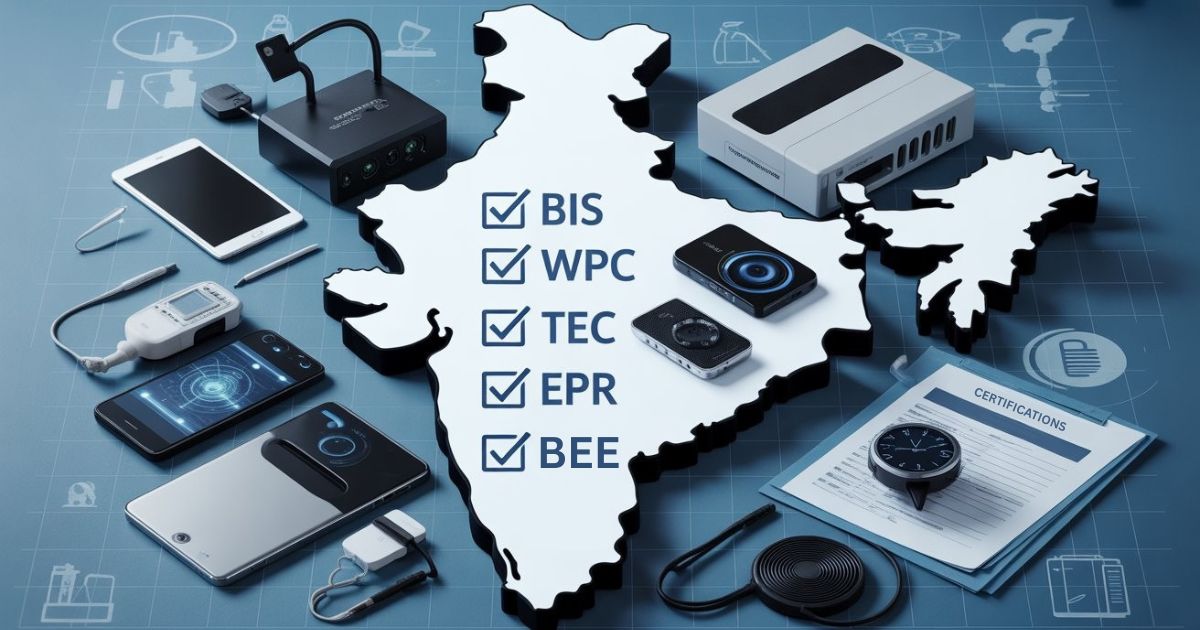
Electronics is one of the fastest-growing industries in India, but the flip side is harsh: compliance rules are tightening every year. Whether you manufacture locally or import devices, you cannot legally sell most electronic products in India without mandatory certifications. The government is serious about safety, quality, and environmental standards and they enforce it through BIS, WPC, TEC, EPR, and BEE.
This guide breaks down every certification required for electronic products in India, why these approvals are non-negotiable, and how Om Garuda Group helps you get them without delays, testing failures, or document errors. If you want to avoid customs blockage, market bans, and penalties, you need to understand the real structure of electronics manufacturing compliance in India.
Why Certifications Matter in Electronics Manufacturing
If you manufacture or import without the required approvals, the consequences aren’t theoretical, you can lose entire shipments. Customs will hold products until you produce the correct certificates. BIS can block your stock, and authorities can impose penalties for non-compliance.
The certification system exists for one reason: safety. Electronics, especially high-voltage or wireless products, can fail, overheat, interfere with communication systems, or cause environmental damage. That’s why regulations demand strict electronics product testing requirements in India before any product hits the market.
Following the correct standards ensures:
- Your product is legally accepted
- You pass customs clearance smoothly
- You avoid penalties and rejection
- You build trust with distributors and consumers
Compliance isn’t optional. It’s the backbone of responsible manufacturing.
BIS Certification for Electronics (Most Important Requirement)
BIS certification for electronics is the biggest compliance wall you cannot cross without proper approvals. Under the Mandatory BIS CRS requirements, over 70+ electronic products must undergo product testing and registration before sale.
Products that fall under BIS CRS include:
- Mobile phones
- LED/LCD TVs
- Laptops and tablets
- Bluetooth speakers
- UPS systems
- Power banks
- Smart watches
- Wireless keyboards and mouse
- LED lighting systems
If your product is on the list, selling it without BIS CRS is illegal.
How the BIS process works:
- Identify the correct IS standard
- Send samples to a BIS-recognized lab
- Complete safety and performance testing
- Upload test reports + documents to the BIS portal
- Apply for CRS registration
- Receive the R-number
Documents needed:
- Product test reports
- Manufacturer’s ISO certificate
- Marking label
- Technical specifications
- Authorization letters
Wrong ISI code, wrong labeling, incomplete documents, your application will be rejected. This is where Om Garuda Group helps you get everything right on the first attempt.
WPC Approval for Wireless & RF-Based Devices
Any product that uses radio frequency, Bluetooth, Wi-Fi, or NFC needs WPC approval for wireless devices before entering the Indian market.
Products requiring WPC ETA approval:
- Wireless speakers
- Wi-Fi routers
- Bluetooth headphones
- RF modules
- IoT devices
- Drones (RF-related parts)
- Smart home devices
ETA (Equipment Type Approval) confirms that your wireless device operates on permissible frequency bands.
Why WPC approval matters:
Without it, customs will immediately seize the shipment. The wireless spectrum is heavily regulated in India, and even minor deviations can cause interference with telecom operations.
WPC ETA process:
- Frequency check
- RF test report (in prescribed format)
- ETA application submission
- Approval issuance
Most delays happen because of incorrect RF test report formatting. Om Garuda Group ensures complete accuracy to avoid resubmissions.
TEC Certification for Telecom Equipment
Telecom devices in India come under the MTCTE scheme, governed by the Telecommunication Engineering Centre (TEC).
If your product transmits, receives, or processes telecom signals, you likely need TEC certification for telecom equipment.
Products that require TEC:
- Routers
- IP phones
- Network switches
- Smart meters
- Session Border Controllers
- Base stations
- Optical fiber equipment
TEC focuses on performance, electromagnetic compatibility, protocols, and safety.
Steps in TEC certification:
- Determine applicable ER (Essential Requirements)
- Lab testing as per TEC norms
- Upload documentation
- Certificate issuance
TEC is one of the toughest approvals because the testing is detailed. Om Garuda Group simplifies the process with pre-compliance guidance.
EPR Authorization for Electronics & E-Waste Management
Every importer and manufacturer of electronic products must obtain EPR authorization for electronics under the E-Waste Management Rules.
The logic is simple:
If you introduce electronics into the market, you’re responsible for their end-of-life disposal.
EPR applies to:
- Producers
- Importers
- OEMs
- Sellers of branded electronics
Documents needed:
- Business license
- Product list
- Technical details
- Recycling agreements
- Annual return commitments
Companies without EPR authorization face penalties, cancellation of import licenses, and environmental non-compliance notices. Om Garuda Group helps establish recycling partnerships and file EPR applications correctly.
BEE Certification for Electronic Appliances
Energy efficiency is non-negotiable in India. Products that consume significant power must carry a star rating label. This makes BEE certification for electronic appliances mandatory for many manufacturers.
Products requiring BEE:
- Refrigerators
- Air conditioners
- LED lights
- Ceiling fans
- Water heaters
- Inverters
Why BEE matters:
- Legally required for high-energy devices
- Impacts market acceptance
- Improves energy efficiency credibility
The process includes product testing, model registration, and verification. Om Garuda Group manages testing coordination and documentation end-to-end.
Import Certification Requirements for Electronic Products
Importing electronics is a lot more complicated than most businesses assume. Customs officers check every certification before clearing a shipment. Missing even one document can result in detention or re-export.
Import certification requirements for electronics in India include:
Mandatory approvals needed for imports:
- BIS CRS certificate
- WPC ETA (if wireless)
- TEC certification (if telecom related)
- EPR authorization (for all producers/importers)
- BEE certification (for appliances)
- Country of origin declaration
- Proper labeling
Typical customs rejection reasons:
- Wrong HS code
- BIS not matching model numbers
- No EPR authorization
- Missing ETA
- Incorrect labeling or MRP
Importing without guidance is asking for delays. Om Garuda Group helps businesses complete all compliance checks before products reach Indian ports.
Understanding Electronics Product Testing Requirements in India
Product testing is the foundation of every certification in India. You cannot bypass it or submit partial results.
Electronics product testing requirements in India include:
Common types of tests:
- Safety testing (IS standards)
- EMI/EMC testing
- RF testing (for wireless devices)
- Energy efficiency testing
- Performance and reliability tests
- Environmental tests
Without proper lab reports from accredited labs, no certification authority will approve your product. Om Garuda Group works with BIS-recognized and NABL-accredited labs to avoid test failures or repeated testing.
How Om Garuda Group Helps You Get These Certifications
Manufacturers and importers often waste weeks or months due to wrong documents, incorrect IS codes, missing samples, or test failures.
Om Garuda Group solves this.
We provide end-to-end support for:
- BIS certification for electronics
- Mandatory BIS CRS requirements
- WPC approval for wireless devices
- TEC certification for telecom equipment
- EPR authorization for electronics
- BEE certification for electronic appliances
- Product testing guidance
- Documentation and labeling compliance
- Import clearance and certification planning
Conclusion
The landscape of electronics compliance in India is getting stricter every year. Whether you manufacture or import, obtaining the right certifications required for electronic products in India is not optional, it’s mandatory for business survival and growth.
From BIS and WPC to TEC, EPR, and BEE, every certification ensures your products meet national safety and performance standards. With correct planning and expert support from Om Garuda Group, you can complete all approvals smoothly and bring your products to market without risk.
If you want fast, accurate, and hassle-free certification support, contact Om Garuda Group and get started today.