
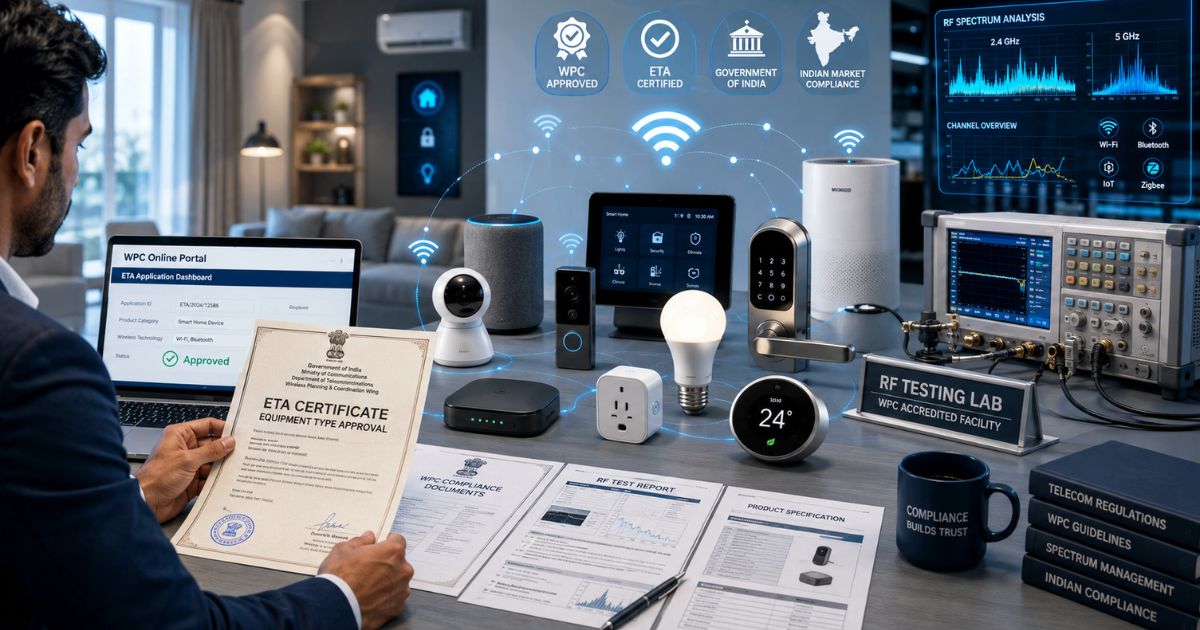
The Indian smart home market is experiencing unprecedented growth, driven by increased adoption of IoT devices, home automation systems, wireless security products, and connected consumer electronics. Products such as smart speakers, smart door locks, Wi-Fi cameras, smart plugs, smart bulbs, and home automation hubs are becoming an integral part of modern households.
However, before importing, selling, or distributing these wireless-enabled devices in India, businesses must comply with the regulatory requirements established by the Wireless Planning and Coordination (WPC) Wing of the Department of Telecommunications (DoT).
One of the most important approvals required for such products is the ETA Certificate (Equipment Type Approval).
In this article, we explain the ETA certification requirements for smart home products in India, the applicable regulations, documentation requirements, compliance challenges, and how businesses can ensure smooth market entry.
What is ETA Certification?
ETA (Equipment Type Approval) is a regulatory approval issued by the Wireless Planning and Coordination (WPC) Wing under the Department of Telecommunications (DoT), Government of India.
ETA approval is required for products containing wireless technologies that operate in India's de-licensed frequency bands.
The purpose of ETA certification is to ensure that radio frequency-enabled products comply with Indian spectrum regulations and do not cause harmful interference to licensed communication networks.
Without ETA approval, eligible wireless products cannot be legally imported, marketed, or sold in India.
Why Smart Home Products Require ETA Certification
Most smart home products rely on wireless communication technologies for connectivity and remote operation.
Common technologies include:
- Wi-Fi
- Bluetooth
- Zigbee
- Z-Wave
- RFID
- NFC
- LoRa (in specific applications)
- Thread Protocol
Since these technologies operate using radio frequencies, they fall under the jurisdiction of the WPC Wing and generally require ETA approval before commercial import.
Smart Home Products That Commonly Require ETA Approval
Manufacturers and importers should evaluate ETA applicability for products such as:
Smart Speakers
- Voice assistants
- AI-powered home assistants
- Wireless audio systems
Smart Security Devices
- Wi-Fi cameras
- Video doorbells
- Motion sensors
- Smart alarm systems
Smart Lighting Solutions
- Smart LED bulbs
- Connected lighting controllers
- Wireless dimmers
Smart Home Automation Systems
- Smart switches
- Smart plugs
- Home automation hubs
- Connected control panels
Smart Appliances
- Wi-Fi enabled air purifiers
- Smart refrigerators
- Connected washing machines
- Smart air conditioners
Smart Access Control Devices
- Smart locks
- Biometric locks
- Wireless access systems
If a device contains an RF (Radio Frequency) module operating in de-licensed frequency bands, ETA approval is generally required.
Understanding De-Licensed Frequency Bands
India permits certain radio frequency bands to operate without an individual user license, subject to compliance with technical specifications prescribed by WPC.
Some commonly used de-licensed bands include:
- 2.4 GHz ISM Band
- 5 GHz Wi-Fi Bands
- Bluetooth Frequency Bands
- Certain RFID Frequency Bands
Products utilizing these frequencies may qualify for ETA approval instead of requiring a separate wireless operating license.
However, technical compliance with WPC requirements remains mandatory.
ETA Certification Process for Smart Home Products
The ETA approval process primarily focuses on verifying the radio frequency characteristics of the product.
Step 1: Product Technical Assessment
Compliance experts first review:
- Product specifications
- RF technologies used
- Frequency range
- Transmit power
- Wireless module details
This assessment determines ETA applicability.
Step 2: RF Test Report Evaluation
One of the most critical requirements for ETA approval is an RF Test Report issued by an accredited laboratory.
The test report must contain:
- Operating frequency details
- Channel information
- Output power measurements
- Modulation characteristics
- Radio frequency parameters
The RF test report serves as the primary technical document used during the ETA application process.
Step 3: Documentation Preparation
Typical documentation includes:
- RF Test Report
- Product datasheet
- Technical specifications
- Authorization letter
- Company incorporation documents
- Importer details
- Product photographs
- User manual
Accurate documentation significantly reduces approval delays.
Step 4: Online ETA Application Submission
The ETA application is submitted through the designated WPC online portal along with supporting technical documents.
Regulatory authorities review the application and evaluate compliance with applicable spectrum requirements.
Step 5: Grant of ETA Approval
Upon successful review, the ETA approval is issued, allowing the product to be imported and sold in India subject to compliance with other applicable regulations.
ETA Certification vs WPC License: Understanding the Difference
A common misconception among importers is that ETA and WPC licensing are the same.
ETA Approval
Applicable to wireless products operating in de-licensed frequency bands.
WPC License
May be required for products operating in licensed spectrum bands or for certain specialized wireless communication systems.
Most consumer smart home devices operate in de-licensed bands and therefore require ETA approval rather than a separate wireless operating license.
Does ETA Certification Apply to Products with Pre-Certified Wireless Modules?
Many smart home products incorporate wireless modules already certified in international markets.
However, the presence of a pre-certified module does not automatically exempt the finished product from Indian compliance requirements.
Importers should evaluate:
- Frequency band compliance
- RF specifications
- Module integration configuration
- Product architecture
A professional compliance assessment is strongly recommended before importation.
ETA Certification and BIS Certification: Do You Need Both?
In many cases, smart home products require multiple regulatory approvals.
For example:
|
Product Type |
ETA |
BIS CRS |
|
Smart Speaker |
Yes |
Often Required |
|
Wi-Fi Camera |
Yes |
May Be Required |
|
Smart Plug |
Yes |
Often Required |
|
Smart LED Product |
ETA Depends |
Often Required |
|
Home Automation Hub |
Yes |
Product-Specific |
Many wireless consumer electronics require both ETA approval and BIS certification before entering the Indian market.
Businesses should conduct a complete regulatory mapping exercise before product launch.
Common Challenges Faced by Importers
Incorrect Frequency Assessment
Many businesses incorrectly assume ETA is not required because products use low-power wireless technologies.
Incomplete RF Test Reports
Missing technical parameters frequently lead to application delays.
Product Categorization Errors
Incorrect classification may result in rejection or additional regulatory scrutiny.
Multiple Regulatory Requirements
Many smart home products simultaneously require:
- ETA Certification
- BIS Certification
- LMPC Registration
- EPR Registration
Failure to identify all applicable regulations can delay product launches.
Benefits of Obtaining ETA Certification
Obtaining ETA approval helps businesses:
✔ Import products legally into India
✔ Avoid customs clearance issues
✔ Reduce regulatory risks
✔ Improve market credibility
✔ Ensure compliance with Indian telecom regulations
✔ Facilitate smooth product launches
For global manufacturers and importers, ETA certification is an essential step toward successful market entry.
How Om Garuda Group Helps with ETA Certification for Smart Home Products
Navigating India's wireless compliance framework can be challenging, especially for importers launching innovative smart home and IoT products.
At Om Garuda Group, we provide end-to-end ETA certification support for manufacturers, importers, distributors, and multinational corporations.
Our services include:
- ETA Applicability Assessment
- Product Compliance Review
- RF Test Report Evaluation
- Documentation Preparation
- WPC ETA Application Filing
- Regulatory Liaison and Follow-up
- BIS + ETA Compliance Mapping
- Import Compliance Advisory
With more than 6 years of industry expertise and over 1000 successful compliance projects, we help businesses achieve faster approvals and seamless market entry into India.
Need ETA Certification for Your Smart Home Products?
Whether you are importing smart speakers, Wi-Fi cameras, smart locks, connected appliances, or complete home automation systems, Om Garuda Group can help you navigate the ETA approval process efficiently and compliantly.
Contact Om Garuda Group today for expert ETA Certification, BIS Registration, LMPC Registration, and regulatory compliance support for the Indian market.
Om Garuda Group – Your Trusted Partner for Product Compliance and Market Access in India.